A. Facts of the Case
1. Company X (“X”), an Indian Company acquired an overseas
Company Y (“Y”) in Canada. The acquisition was to be funded by
contribution by Company X by way of an equity contribution of
USD 450 mn to a Special Purpose Vehicle – Netherlands
incorporated company (“SPV 1”) and the balance money was by
loans drawn by this SPV and others specifically created for this
purpose. The payment structure was as follows:
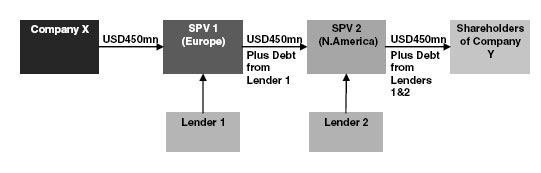
2. SPV 1 issued equity shares denominated in Euro to X. SPV 2
issued equity denominated in USD to SPV 1.
3. X had put in the bid for company Y during last week of
January ’07 and Y communicated to X on 20th February, ’07 that
they have been chosen as the preferred bidder. The transaction
had to be paid for and consummated by 15th May, ’07. To protect
against currency fluctuations, X entered into some forward contracts
and option contracts during last week of March ’07 and early April
’07 for USD 380 mn out of the total USD 450 mn exposure. Since
the exact payment dates were not known at that stage but the
expectation was that the deal would be closed not later than 31st
May and ideally around 15th May. Hence, X entered into derivatives
maturing around the expected payment date ranging from end
April to May 15th.
4. Significant portion of the derivative contracts was in the form
of Zero Cost Collar options, i.e., these derivatives provide the
holder a right to buy Dollars. However, instead of paying premium
the holder writes a compensating sell option. In the present case,
X has entered into leveraged options, i.e., where the pay off on
the written sell option is higher than the bought call option. X has
also entered into other variants of options.
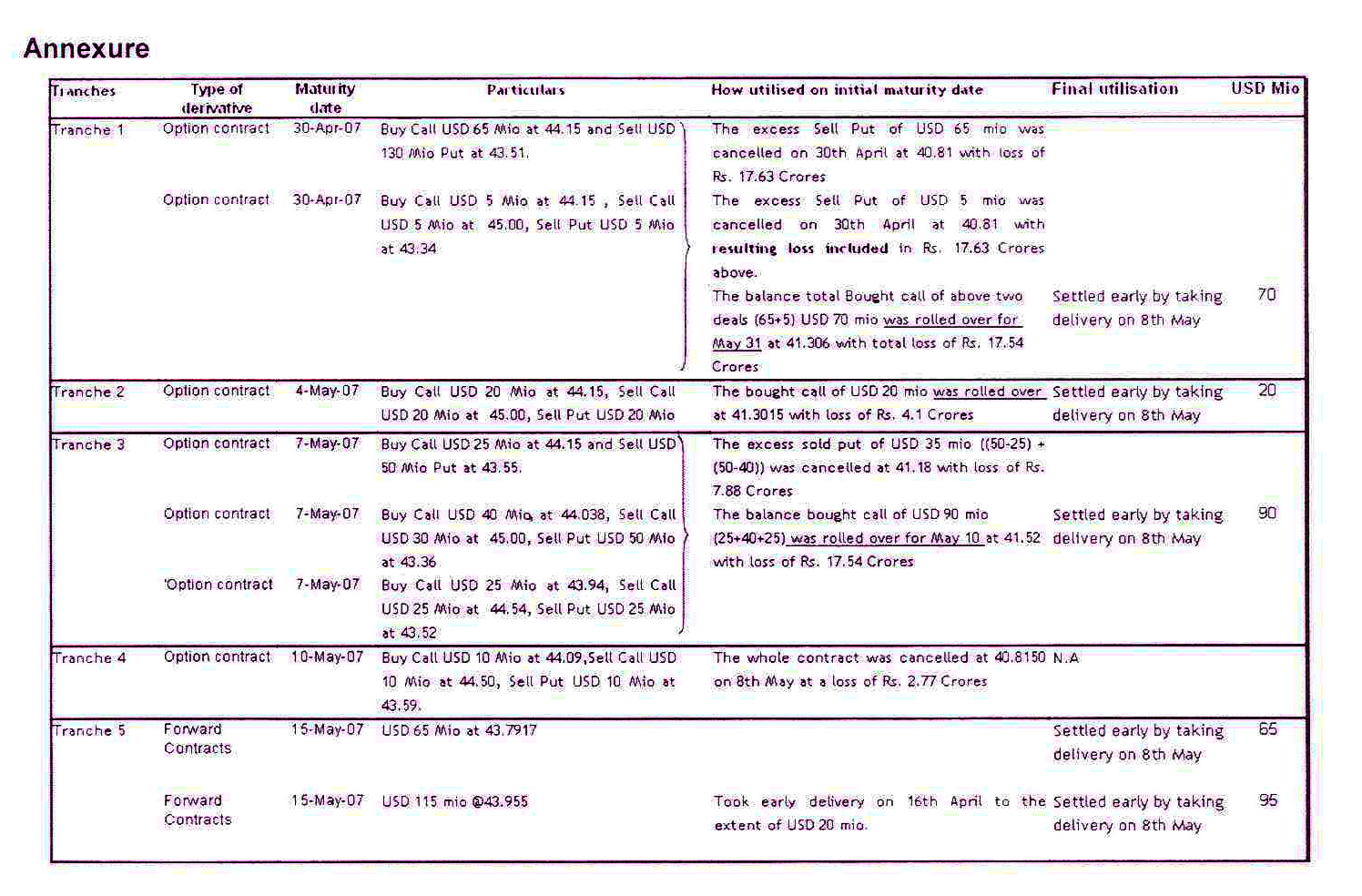
5. The details of the derivative instruments and the activity therein
are as set out in the Annexure.
6. The actual payments were made as follows:
16-Apr-07 USD 70 mn USD 50 mn purchased from market
USD 20 mn from early delivery from
Tranche 5
8-May-07 USD 380 mn USD 340 mn was used by taking
delivery
against the derivative
contracts on 8th May
as set out in
table given in the Annexure.
USD 40 mn was purchased from
market
7. X has accounted for the losses incurred on various dates on
cancellation of the leveraged portion of the options and roll-forward
of the option contracts amounting to approximately Rs. 67 crore
as expense in the profit and loss account of the relevant period.
8. The net impact of settlement of the forward contracts on May
8, 2007 was not material.
B. Query
9. The querist has sought the opinion of the Expert Advisory
Committee on the following issues arising from the above:
(i) Whether the losses incurred (refer paragraph 7 above)
on the derivatives contracted for hedging the cash
outflow for equity investments can be considered as a
direct cost of acquisition and accordingly, added to the
cost of investments or would the losses have to be
taken to the profit and loss account.
(ii) Whether the combination of call and put options can be
considered as a forward exchange or another financial
instrument that is in substance a forward exchange
contract as in paragraph 36 of Accounting Standard
(AS) 11, ‘The Effects of Changes in Foreign Exchange
Rates’, and thus, be accounted for as forward contracts.
In the absence of any specific guidance for accounting
for option contracts what would be the primary source
of technical guidance for its accounting/disclosures
including the option contracts entered for hedging the
forecast transaction.
(iii) If it is agreed that these transactions are not covered by
existing Indian Accounting Standards, then whether
reference can be made to International Accounting
Standard (IAS) 39, ‘Financial Instruments: Recognition
and Measurement’, only for these transactions, i.e., not
adopt IAS 39 in its entirety, including potential for
claiming hedge accounting under IAS 39.
C. Points considered by the Committee
10. The Committee notes that the company in question had
entered into certain options and forward contracts to cover the
foreign currency risk to purchase an investment in future. In other
words, the aforesaid derivative contracts were entered into in
expectation of purchase of an investment in future.
11. The Committee notes that paragraph 36 of AS 11 provides as
below:
“36. An enterprise may enter into a forward exchange
contract or another financial instrument that is in
substance a forward exchange contract, which is not
intended for trading or speculation purposes, to establish
the amount of the reporting currency required or available
at the settlement date of a transaction. The premium or
discount arising at the inception of such a forward
exchange contract should be amortised as expense or
income over the life of the contract. Exchange differences
on such a contract should be recognised in the statement
of profit and loss in the reporting period in which the
exchange rates change. Any profit or loss arising on
cancellation or renewal of such a forward exchange
contract should be recognised as income or as expense
for the period.”
12. The Committee also notes that the above paragraph of AS 11
does not apply to forward exchange contracts to cover a future
transaction. In this context, the Committee notes that the Institute
of Chartered Accountants of India had issued, in January 2006, an
Announcement titled as ‘Accounting for exchange differences
arising on a forward exchange contract entered into to hedge the
foreign currency risk of a firm commitment2 or a highly probable
forecast transaction3’. The said Announcement is reproduced below:
“1. The Institute of Chartered Accountants of India (ICAI)
issued an Announcement, on ‘Applicability of Accounting
Standard (AS) 11 (revised 2003), The Effects of Changes in
Foreign Exchange Rates, in respect of exchange differences
arising on a forward exchange contract entered into to hedge
the foreign currency risk of a firm commitment or a highly
probable forecast transaction (see ‘The Chartered Accountant’,
July 2004 (pp. 110)). As per the Announcement, AS 11 (revised
2003) is not applicable to the exchange differences arising on
forward exchange contracts entered into to hedge the foreign
currency risks of a firm commitment or a highly probable
forecast transaction. It is stated in the Announcement that the
hedge accounting, in its entirety, including hedge of a firm
commitment or a highly probable forecast transaction, is
proposed to be dealt with in the Accounting Standard on
‘Financial Instruments: Recognition and Measurement’, which
is under formulation.
2. It may be noted that as per the above Announcement,
AS 11 (revised 2003) is not applicable to the exchange
differences arising on the forward exchange contracts entered
into to hedge the foreign currency risks of a firm commitment
or a highly probable forecast transaction. Accordingly, the
premium or discount in respect of such contracts continues to
be governed by AS 11 (revised 2003), The Effects of Changes
in Foreign Exchange Rates.
3. It has been noted that in the absence of any authoritative
pronouncement of the Institute on the subject, different
enterprises are accounting for exchange differences arising
on such contracts in different ways which is affecting the
comparability of financial statements. Keeping this in view,
the matter has been reconsidered and the Institute is of the
view that pending the issuance of the proposed Accounting
Standard on ‘Financial Instruments: Recognition and
Measurement’, which is under formulation, exchange
differences arising on the forward exchange contracts entered
into to hedge the foreign currency risks of a firm commitment
or a highly probable forecast transaction should be recognised
in the statement of profit and loss in the reporting period in
which the exchange rate changes. Any profit or loss arising
on renewal or cancellation of such contracts should be
recognised as income or expense for the period.”
13. The Committee notes that the above Announcement had been
deferred by subsequent Announcements made by the ICAI in
February 2006, June 2006 and July 2007.
14. With regard to whether the losses on derivatives should have
been added to the cost of investments, the Committee also notes
paragraph 28 of Accounting Standard (AS) 13, ‘Accounting for
Investments’, which requires as follows:
“28. The cost of an investment should include acquisition
charges such as brokerage, fees and duties.”
15. The Committee is of the view that the requirement of the
above paragraph of AS 13 covers charges on acquisition and,
accordingly, it does not include losses on derivative contracts as a
part of cost of investments.
16. The Committee is of the view that the nature of options
contracts or the combination thereof as per the facts of the case is
different from the forward contacts or their combination and
accordingly, the options contracts or their combination cannot be
considered as a forward exchange contract or another financial
instrument that is in substance a forward exchange contract for
the purposes of paragraph 36 of AS 11 and the Announcements
mentioned in paragraphs 12 and 13 above. The Committee is,
therefore, of the view that insofar as option contracts are concerned,
since there was no pronouncement of the ICAI, the company
could have adopted any rational treatment. Thus, recognising losses
on the options contracts was in order, keeping in view the principle
of prudence. Insofar as forward contracts were concerned, although
the Announcement reproduced in paragraph 12 above had been
deferred, the said Announcement formed the only authoritative
source of accounting for a forward transaction of a highly probable
forecast transaction. Thus, in case the concerned transaction met
the definition of the highly probable forecast transaction, recognition
of the loss thereon in the profit and loss account was in order.
17. It may be noted that the Institute of Chartered Accountants of
India has issued Accounting Standard (AS) 30, ‘Financial
Instruments: Recognition and Measurement’, corresponding to IAS
39. AS 30 becomes recommendatory in respect of accounting
periods beginning 1st April, 2009 and mandatory from 1st April,
2011. In view of the fact that options contracts are not forward
exchange contracts or another financial instrument that is in
substance a forward exchange contract as envisaged in paragraph
36 of AS 11, the company can follow AS 30 with regard to hedge
accounting provisions in case the combination(s) of options taken
by the company constitute(s) a hedging instrument(s), after having
satisfied all the requirements related to hedge accounting, e.g.,
those related to hedge effectiveness, documentation, etc.
D. Opinion
18. On the basis of the above, the opinion of the Committee on
the issues raised by the querist in paragraph 9 are as below:
(i) Losses incurred on the derivative contracts for hedging
the cash outflow for equity investments cannot be
considered as a direct cost of acquisition thereof and
accordingly, should not have been added to the cost of
investments. The treatment followed by the company to
recognise these losses in the profit and loss account
was in order.
(ii) Combination of call and put options cannot be considered
as a forward exchange or another financial instrument
that is in substance a forward exchange contract as
envisaged in paragraph 36 of AS 11. For authoritative
source of technical guidance for options contracts please
see (iii) below.
(iii) In view of the fact that options contracts are not forward
exchange contracts or another financial instrument that
is in substance a forward exchange contract as envisaged
in paragraph 36 of AS 11, the company can follow AS
30, corresponding to IAS 39, with regard to hedge
accounting provisions in case the combination(s) of
options taken by the company constitute(s) a hedging
instrument(s) after having satisfied all the requirements
related to hedge accounting, e.g., those related to hedge
effectiveness, documentation, etc.
1Opinion finalised by the Committee on 13.11.2007.
2A firm commitment is a binding agreement for the exchange of a specified
quantity of resources at a specified price on a specified future date or dates.
3A forecast transaction is an uncommitted but anticipated future transaction.
|