|
Query No. 14
Subject:
Accounting for deferred taxes.1
A. Facts of the Case
1. A Government of India enterprise under the Ministry of Steel
had been incurring losses from the financial year 1998-99 to
2003-04. As a result, the company is having unabsorbed
depreciation and accumulated losses. However, the company is paying Minimum Alternative Tax (hereafter referred to as ‘MAT’)
under section 115JB of the Income-tax Act, 1961.
2. The querist has referred to paragraph 17 of Accounting
Standard (AS) 22, ‘Accounting for Taxes on Income’, issued by
the Institute of Chartered Accountants of India, which states that
where an enterprise has unabsorbed depreciation or carry forward
of losses under tax laws, deferred tax assets should be recognised
only to the extent that there is virtual certainty supported by
convincing evidence that sufficient future taxable income will be
available against which such deferred tax assets can be realised.
The querist has informed that though the company had unabsorbed
depreciation and losses from financial year 1998-99 to 2003-04,
as per the above provisions of AS 22, it did not recognise deferred
tax assets due to lack of virtual certainty that sufficient future
taxable income will be available for realisation of the deferred tax
assets. For the year 2004-05 also, it did not recognise deferred
tax assets since the ‘virtual certainty’ condition was not met. The
querist has further informed that upto the financial year 2004-05,
as per financial data, only deferred tax asset was arising and
hence, the question of providing for deferred tax liability did not
arise.
3. During the financial year 2005-06, for the first time, the
company recognised deferred tax liability for Rs.170 lakh based
on provisional accounts. Again, during the financial year 2006-07,
deferred tax assets arose, which were not recognised for the
reasons stated in paragraph 2 above. At the same time, the
company did not reverse the opening deferred tax liability for Rs.170
lakh (created in the year 2005-06) during the financial year 2006-
07 and maintained the same figure in the balance sheet as at 31st
March, 2007.
4. The querist has informed that there were some items which
were getting reversed in the financial year 2006-07, like, provision
for bad debts, provision for liquidated damages, provision for
gratuity, expenditure on voluntary retirement scheme, etc.
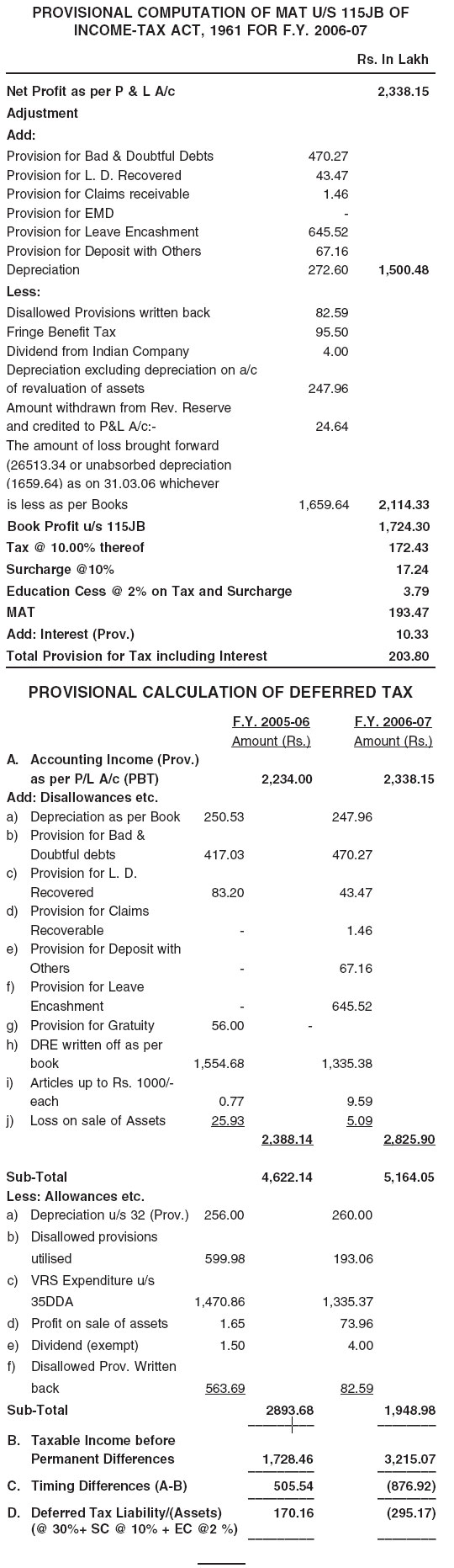
5. The querist has supplied provisional computation of MAT under
section 115JB of the Income-tax Act, 1961 for the financial year
2005-06 and provisional calculation of deferred tax which is
contained in the Annexure, for the reference and perusal of the
Committee.
B. Query
6. Keeping the above in view, the querist has sought the opinion
of the Expert Advisory Committee on the following issues:
(i) Whether the company should reverse the deferred tax
liability created previously and make it nil during the
current year or the company should maintain the same
figure as deferred tax liability unless and until further
deferred tax liability is created or reduced as long as
the deferred tax asset is not recognised by the company.
(ii) Whether book profit as per the provisions of MAT will
be considered as taxable income for the purpose of
calculation of timing difference as per AS 22, when the
company is paying MAT or taxable income shall be
computed as per regular provisions of the Income-tax
Act to find out timing difference (i.e., difference between
accounting income and taxable income before permanent
difference).
C. Points considered by the Committee
7. The Committee notes that AS 22 deals with accounting for
both current tax and deferred tax. The principle underpinning
accounting for deferred taxes is that tax consequences of a
transaction should be recognised in financial statements during
the same period in which the underlying transaction is recognised
in the financial statements. Thus, accounting for deferred taxes
ensures proper matching of tax expense (saving) and the related
income (expense) recognised for accounting purposes.
8. From the information supplied by the querist in the Annexure,
the Committee notes that the basics of deferred tax accounting
have not been properly followed. The querist has started from
accounting income and made some adjustments to derive what
has been described as ‘taxable income before permanent
differences’. The difference between the two, which is naturally equal to the net effect of the adjustments made, has been described
as ‘timing differences’, which is multiplied by the tax rate and the
resulting figure has been stated as deferred tax liability or deferred
tax asset, as the case may be. Apart from deviation from the
principles of AS 22, this approach can lead to misleading results.
For example, some items, like, creation of provision for bad and
doubtful debts may result in deferred tax asset while excess of
depreciation for income-tax purposes over book depreciation
originating during the period may result in deferred tax liability.
Clubbing all differences into a one-line figure and describing the
same as ‘timing differences’ will result in set-off of deferred tax
assets against deferred tax liabilities even before prudence test is
applied which will distort the real picture. This may result in
understatement of deferred tax liabilities and overstatement of
profit, if prudence test fails on assessment of deferred tax assets
separately instead of mixing up with deferred tax liabilities. There
are other errors of principle also. For example, dividend income
exempted from tax has been deducted from accounting income
while deriving the so called ‘taxable income before permanent
differences’. It is a permanent difference. But, the one-line figure
described as ‘timing differences’ includes effect of dividend
exempted from tax. In other words, a permanent difference is
included in, and wrongly described as, timing difference. Thus,
though the querist has listed some sources of differences between
accounting income and taxable income, these have not been
properly segregated into permanent differences and timing
differences. Further, failure to segregate the timing differences
into originating and reversing differences may lead to incorrect
results. For example, a reversing timing difference in respect of a
deferred tax liability might be wrongly understood as an originating
timing difference in respect of a deferred tax asset. Also, there is
no such concept of ‘taxable income before permanent difference’
as mentioned by the querist. There is only accounting income
adjusted for permanent differences. There are also differences in
the amounts of some items between the provisional calculation
sheet of deferred taxes and the financial statements. While the
Committee notes the above points, it has not gone into the
correctness of computation of MAT and deferred tax liability, since
the query relates to principles only.
9. The requirements of AS 22, so far as measurement of deferred
taxes is concerned, are briefly summarised below:
(i) Normally, differences arise between accounting income
and taxable income. Such differences are classified as
timing differences and permanent differences. Timing
differences originate in one period and are capable of
reversal in one or more subsequent periods. Timing
differences arise because the period in which some
items of income and expenses are included in taxable
income does not coincide with the period in which these
are included or considered in arriving at accounting
income. Unabsorbed depreciation and losses are also
considered as timing differences. Permanent differences
are those that arise in a period but do not reverse
subsequently.
(ii) Permanent differences affect only current tax. They do
not affect deferred taxes.
(iii) Timing differences that are originating in a period may
result in creation of either deferred tax assets or deferred
tax liabilities, with corresponding credit/debit to the profit
and loss account. The deferred tax assets and liabilities
should be measured using the tax rates and tax laws
that have been enacted or substantively enacted by the
balance sheet date.
(iv) Timing differences that are reversing during the period
will result in liquidation (i.e., clearance) of the whole or
part of deferred tax assets/ deferred tax liabilities, already
created at the time of origination of timing differences,
with corresponding debit/credit to the profit and loss
account. For example, if depreciation for accounting
purposes for the period is less than depreciation for
income-tax purposes, a deferred tax liability arises. This
is because in future, depreciation for income-tax
purposes will be less than depreciation for accounting
purposes. Thus, while tax based on taxable income for
the current period is less than tax based on accounting income due to difference in depreciation, for future
period, tax based on taxable income will be more than
tax based on accounting income. Hence, a deferred tax
liability is provided for in the current period and cleared
in future when the depreciation difference reverses. This
matches tax expense with accounting income both for
the current period and the future period.
(v) While deferred tax liabilities should be recognised as
such, deferred tax assets should be considered
separately from deferred tax liabilities and recognised
only if the ‘prudence test’ is met. Accordingly, deferred
tax assets should be recognised and carried forward
only if there is a reasonable certainty that sufficient
taxable income will be available against which such
deferred tax assets can be realised. However, in case
an enterprise has unabsorbed depreciation or carry
forward losses, deferred tax assets should be recognised
only to the extent that there is virtual certainty supported
by convincing evidence that sufficient future taxable
income will be available against which such deferred
tax assets can be realised. The concepts of ‘reasonable
certainty’ and ‘virtual certainty’ have been explained in
relevant portions of AS 22. Deferred tax liabilities such
as those in (iv) above should be recognised even if the
deferred tax assets are not recognised.
(vi) As a corollary to point (v) above, originating timing
differences resulting in deferred tax assets and those
resulting in deferred tax liabilities should be separately
considered. They should not be mingled to see their
overall net effect. Further, to the extent a deferred tax
asset is not recognised in respect of an originating
difference due to failure to meet the prudence test, both
the origination and reversal of that difference will not
have deferred tax effects.
(vii) At each balance sheet date, an assessment should be
made of both unrecognised and recognised deferred
tax assets. To the extent prudence test is met, the former should be recognised and to the extent it is not
met, the carrying amount of the latter should be written
down. The corresponding adjustment should be
recognised in the profit and loss account. Reversal of a
previous write-down of deferred tax assets is also
permitted to the extent prudence test is subsequently
met.
10. The Committee notes that as per an announcement made by
the Council of the Institute of Chartered Accountants of India, tax
effect of any item should be recognised and presented in a manner
consistent with the manner in which that item itself is recognised
and presented. Thus, for example, if an item of income/expense is
directly adjusted in reserves, it should be net of tax effect. In other
words, the tax effect is also recognised in the reserves.
11. Thus, the basic steps involved in deferred tax accounting are
as follows:
(i) Identify the sources of differences between accounting
income and taxable income and their amounts.
(ii) Classify the differences between permanent differences
and timing differences.
(iii) Make further analysis of each item of timing difference
into originating differences and reversing differences.
(iv) Recognise deferred tax liabilities in full in respect of
originating timing differences during the period using
tax rates and tax laws that have been enacted or
substantively enacted by the balance sheet date.
(v) Liquidate deferred tax liabilities to the extent of reversal
of timing differences during the period in respect of
which they were created.
(vi) Recognise deferred tax assets in respect of originating
timing differences during the period to the extent
prudence test is met, using tax rates and tax laws that
have been enacted or substantively enacted by the
balance sheet date.
(vii) Liquidate deferred tax assets to the extent of reversal of
timing differences during the period in respect of which
they were created.
(viii) Reassess at each balance sheet date both unrecognised
and recognised timing differences. To the extent
prudence test is met, recognise deferred tax asset for
the former, using tax rates and tax laws that have been
enacted or substantively enacted by the balance sheet
date and to the extent the prudence test is not met,
write-down the carrying amount of the latter. Such writedown
can be reversed to the extent prudence test is
subsequently met.
(ix) Any deferred tax assets and liabilities previously created
and still appearing in the balance sheet because the
whole or a part of the timing differences in respect of
which they were created are yet to reverse, should be
adjusted for the effect of changes in tax laws and tax
rates, if any, enacted or substantively enacted by the
balance sheet date.
12. Thus, difference between accounting income adjusted for
permanent differences, and taxable income computed under tax
laws should be the net effect of originating as well as reversing
timing differences. As already explained, such a difference should
be analysed source-wise with further analysis into originating and
reversing differences, to ascertain and account for their deferred
tax impact. The Committee notes that this has not been followed
as per the Facts of the Case.
13. Further, the Committee notes that AS 22 has transitional
provisions, which should have been followed on the date on which
it became mandatory for the company.
14. The company should pass necessary rectification entries. For
this purpose, the company should ascertain the entries that should
have been passed in accordance with the principles stated above,
right from the time AS 22 became mandatory to it, assess their net
effect and consequential changes, if any (such as, initial adjustment of transitional deferred tax liability against debit balance in the
profit and loss account because of inadequacy of revenue reserves
and clearance of the said debit balance against subsequent profits),
and compare the same with the effect of the entries actually passed
right from the time AS 22 became mandatory. Adjustments
pertaining to previous periods should be treated as prior period
items in accordance with Accounting Standard (AS) 5, ‘Net Profit
or Loss for the Period, Prior Period Items and Changes in
Accounting Policies’. The Committee is of the view that though AS
5 deals with prior period items in the context of profit and loss
account only, the accounting principles of prior period items are
equally applicable to balance sheet items also.
15. As regards ‘MAT’, the Committee notes that the Institute of
Chartered Accountants of India has issued Accounting Standards
Interpretation 6, ‘Accounting for Taxes on Income in the context of
Section 115JB of the Income-tax Act, 1961’, which has been
subsequently withdrawn and the consensus of the same has been
inserted as Explanation to paragraph 21 of AS 22 notified by the
Central Government under the Companies (Accounting Standards)
Rules, 2006. This Explanation reads as below:
“Explanation:
(a) The payment of tax under section 115JB of the
Income-tax Act, 1961 (hereinafter referred to as the
‘Act’) is a current tax for the period.
(b) In a period in which a company pays tax under
section 115JB of the Act, the deferred tax assets
and liabilities in respect of timing differences arising
during the period, tax effect of which is required to
be recognised under this Standard, is measured
using the regular tax rates and not the tax rate under
section 115JB of the Act.
(c) In case an enterprise expects that the timing
differences arising in the current period would
reverse in a period in which it may pay tax under
section 115JB of the Act, the deferred tax assets
and liabilities in respect of timing differences arising during the current period, tax effect of which is
required to be recognised under AS 22, is measured
using the regular tax rates and not the tax rate under
section 115JB of the Act.”
16. As regards the computation of timing differences in the context
of ‘MAT’, the Committee notes that section 115JB is an independent
section which operates in a particular situation where the tax
payable under the normal provisions is less than 10 per cent of
the book profit as determined under that section. The ‘book profit’
for the purposes of ‘MAT’ may or may not be equal to accounting
income. Section 115JB does not in any way alter the taxable
income computed under the normal provisions of the tax law.
17. From the above, the Committee is of the view that while
arriving at timing differences, treatment of items of income and
expense for accounting purposes should be compared with the
treatment of such items for computation of taxable income under
the normal provisions of tax law. Those differences, if any, which
are not permanent in nature, will be timing differences. Treatment
of incomes and expenses for computation of book profit for the
purposes of MAT is irrelevant for computing timing differences.
The timing differences should be analysed item-wise and also
further analysed into originating and reversing differences.
D. Opinion
18. On the basis of the above, the Committee is of the following
opinion on the issues raised in paragraph 6 above:
(i) The company should have followed the proper approach
to deferred tax accounting as explained above. Since
this was not done, necessary rectification entries as
stated in paragraph 14 above should be passed.
Thereafter, the reversal of the deferred tax liability
created in accordance with the aforesaid procedure
should be done, if appropriate, as explained in the above
paragraphs.
(ii) Book profit as per the provisions of MAT should not be
considered as taxable income for the purposes of AS 22. Differences in treatment of items of expenses and
income for accounting purposes as compared to
computation of income for tax purposes under normal
tax provisions (instead of computation of book profit for
MAT purposes), which are not permanent in nature,
should be considered in arriving at timing differences in
the year of payment of MAT.
Annexure
1 Opinion finalised by the Committee on 30.5.2008
|