|
A. Facts of the Case
1. A company is engaged in retail business operations over the
years. The company has been in footwear business since 1965
and has entered into Large Format Retail (hereinafter referred to
as ‘LFR’) business from the year 2005. Both the business lines
have been operated through ‘Hub ‘n Spoke’ module. At present
the footwear business of the company is being operated through
wholesale and retail outlets, and distribution centres across 22
Indian states and one manufacturing unit at Kolkata. Approximately
80% of the total footwear products traded under the company’s
brand name are procured from outside suppliers and the rest 20%
are manufactured at the company’s own manufacturing unit. Under
LFR business, the large number of rapidly changing merchandise
includes apparels, home need items, grocery items, etc. and the stores have been operated with a central warehouse. 100 per cent
of the products traded under LFR business are procured from
outside suppliers.
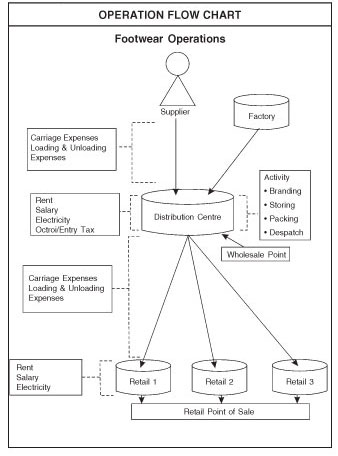
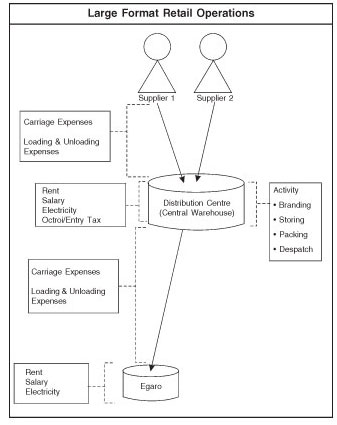
2. The operation activity flow of the company is as follows:
Footwear division:
(i) All finished goods are either manufactured at company’s
factory or procured from outside suppliers.
(ii) Purchased finished goods are branded and packed at
company’s own distribution centres either for further
despatch to the retail locations of sales across the
country or sold in bulk under wholesale terms at the
distribution centres itself.
(iii) Finished goods despatched to retail outlets from
distribution centres are stored at retail locations for sale
in due course.
LFR division:
(i) Life style retail merchandise are procured from outside
suppliers.
(ii) Own branded merchandise are branded and packed at
supplier end.
(iii) Suppliers deliver merchandise, both own brand or other
brand, either at central warehouse or direct to stores
locations.
(iv) Merchandise received in central warehouse is affixed
with bar code, packed and forwarded to stores locations.
(v) From stores location, own brand and other brand,
merchandise are sold to retail customers.
3. As per the querist, the method and basis of inventory valuation
presently followed are as below:
(i) In line with Accounting Standard (AS) 2, ‘Valuation of
Inventories’, paragraph 18, inventories at different locations are considered under cost method for
measurement of value.
(ii) Similarly, the value of inventories has been assigned by
using FIFO formula as per paragraph 16 of AS 2.
4. The operation flow charts of both the divisions are as follows:
B. Query
5. The querist has sought the opinion of the Expert Advisory
Committee on the following issues:
(i) Whether rent, electricity and salary of the personnel
working for footwear distribution centres (DCs) where
merchandise are branded, packed and stored primarily before despatch towards retail point of sales, should be
considered in determining cost of footwear inventory at
DC level. (Emphasis supplied by the querist.)
(ii) As the company is operating through ‘Hub ‘n Spoke’
module, whether, carriage inwards cost and loading and
unloading costs incurred at footwear retail outlet points
in bringing the inventories to their present condition and
location, on being despatched from distribution centers,
should be included in determining cost of inventory at
footwear retail level. (Emphasis supplied by the querist.)
(iii) Whether rent and part of electricity charges that is directly
relatable to footwear storage, paid for footwear retail
outlets where merchandise has to be stored, as per
retail industry business practices, irrespective of
merchandise type/nature, time of sale, quantum of sale,
should be considered in determining cost of inventory
at footwear retail level. It is also to be considered that
goods have to be kept and maintained at retail store for
a considerable time before sale. (Emphasis supplied by
the querist.)
(iv) Whether rent, electricity charges and salary of
procurement and merchandising staff should be
considered in arriving at landed cost of merchandise
held at LFR–DC. [At LFR - DC major activities are (a)
branding, (b) tagging, (c) packing (d) storing and (e)
despatch to LFR retail store.] (Emphasis supplied by
the querist.)
(v) Whether rent, salary of logistics staff and portion of
electricity charges that is directly relatable to
merchandise storage at LFR store should be considered
in arriving at landed cost of merchandise held at LFR
store. [At LFR store major activities are (a) merchandise
supply chain management at store level, (b) storing, (c)
merchandise display and (d) sale. In LFR business,
numerous and variety of merchandise, backed by
intelligent logistics support, has to be maintained and carried at store level as per industry demand.] (Emphasis
supplied by the querist.)
C. Points considered by the Committee
6. The Committee notes that the basic issue raised by the querist
relates to inclusion of certain items as costs of inventories in
distribution centres (hereinafter referred to as ‘DCs’) and retail
outlets of Footwear and LFR businesses. Therefore, the Committee
has examined only this issue and has not examined any other
issue that may be contained in the Facts of the Case, such as,
valuation of inventories, cost formula, etc. Further, the Committee
restricts itself to the specific activities mentioned by the querist in
the issues raised. The Committee also notes that the querist has
used the expression ‘landed cost of merchandise’ in the Facts of
the Case without explaining its meaning. The Committee, in its
opinion given hereinafter, has considered the expenses referred to
in this regard from the point of view of whether the same should
be included in the cost of inventories concerned.
7. The Committee notes that the Institute of Chartered
Accountants of India has issued Accounting Standard (AS) 2,
‘Valuation of Inventories’, which has also been notified by the
Central Government under the Companies (Accounting Standards)
Rules, 2006. The Committee notes the following paragraphs from
AS 2:
“6. The cost of inventories should comprise all costs of
purchase, costs of conversion and other costs incurred
in bringing the inventories to their present location and
condition.
Costs of Purchase
7. The costs of purchase consist of the purchase price
including duties and taxes (other than those subsequently
recoverable by the enterprise from the taxing authorities),
freight inwards and other expenditure directly attributable to
the acquisition. Trade discounts, rebates, duty drawbacks and
other similar items are deducted in determining the costs of
purchase.
Costs of Conversion
8. The costs of conversion of inventories include costs
directly related to the units of production, such as direct labour.
They also include a systematic allocation of fixed and variable
production overheads that are incurred in converting materials
into finished goods…”
“11. Other costs are included in the cost of inventories only
to the extent that they are incurred in bringing the inventories
to their present location and condition. For example, it may be
appropriate to include overheads other than production
overheads or the costs of designing products for specific
customers in the cost of inventories.”
“13. In determining the cost of inventories in accordance with
paragraph 6, it is appropriate to exclude certain costs and
recognise them as expenses in the period in which they are
incurred. Examples of such costs are:
(a) abnormal amounts of wasted materials, labour, or other
production costs;
(b) storage costs, unless those costs are necessary in the
production process prior to a further production stage;
(c) administrative overheads that do not contribute to
bringing the inventories to their present location and
condition; and
(d) selling and distribution costs.”
8. From the above, the Committee notes that as per AS 2, the
cost of inventories would include costs other than cost of purchase
and cost of conversion as are incurred in bringing the inventories
to their present location and condition. The Committee is of the
view that the test for determining whether or not the cost of carrying
out a particular activity should be included in the cost of inventories
is whether the activity contributes to bringing the inventories to
their present location and condition; the nomenclature of the activity
or the place where the activity is carried out is not relevant.
9. The Committee is of the view that the term ‘distribution costs’ referred to in paragraph 13(d) of AS 2 reproduced above read with
paragraph 6 of AS 2, should be construed as distribution costs
which are incurred by the seller in making the goods available to
the buyer from the point of sale. In other words, distribution costs
used in the expression ‘selling and distribution costs’ would include
only those costs which are incurred for moving the goods from the
premises of the seller, whether from the factory or DCs or retail
outlets to the premises of the buyer. It does not include the cost of
moving the goods from the factory to DCs or from DCs to seller’s
retail outlets before sale.
10. The querist refers to the activities of the Footwear DCs as
branding (seems to be for purchased items), packing and storing
before despatch to retail outlets. The Committee is of the view
that rent, electricity and salary of the personnel working for
Footwear DCs are, in effect, product costs to the extent they are
related to branding because these are incurred in changing the
condition of the product from unbranded to branded. Since these
expenses are incurred in bringing the inventory to a saleable
condition, i.e., branded condition as intended by the management,
the same should be included in the cost of footwear inventory in
accordance with paragraph 6 of AS 2. The Committee also notes
that the above-mentioned expenses are storage cost to the extent
these are related to storage activity. Since the footwear
merchandise at the DCs are already finished goods requiring no
further processing, the storage cost incurred at the DCs is not of
the type which is necessary in the production process prior to a
further production stage. Hence, inclusion of such storage cost in
the cost of footwear inventory at DC level is prohibited by paragraph
13(b) of AS 2. As regards packing, the treatment of the aforesaid
expenses related to packing depends on whether packing material
cost itself is includible in the cost of inventories or not, which, in
turn, depends on the nature of packing.
11. As regards carriage inwards cost and loading and unloading
costs incurred at footwear retail outlet points in bringing the
inventories to their present condition and location, on being
despatched from DCs, the Committee is of the view that the same
should be included in the cost of inventories at retail footwear
level as required by paragraph 11 read with paragraph 6 of AS 2,
whether or not ‘Hub ‘n Spoke’ module is operated. For the reasons stated in paragraph 9 above, the Committee is of the view that these
are not ‘distribution costs’ mentioned in paragraph 13(d) of AS 2.
12. The Committee notes that at the footwear retail outlets, the
footwear merchandise are already finished goods requiring no
further processing. Hence, the cost of storing such goods in the
retail outlets is not of the type which is necessary in the production
process prior to further production stage. Hence, rent and part of
electricity charges, whether or not directly relatable to footwear
storage, paid for footwear retail outlets should not be included in
the cost of footwear inventory at the retail level as the inclusion of
the same is prohibited by paragraph 13(b) of AS 2.
13. The querist states that at the LFR – DC (which is the central
warehouse), major activities are (a) branding, (b) tagging, (c)
packing (d) storing and (e) despatch to LFR retail store. All
merchandise at LFR-DC are meant for despatch to retail outlets.
The Committee is of the view that to the extent the activities of the
procurement and merchandising staff are related to branding, the
salary of staff would be product costs for the reasons stated in
paragraph 10 above and, hence, should be considered in arriving
at the cost of inventories held at LFR-DC. Further, the Committee
is of the view that to the extent their activities are related to
tagging, their salary would also be product costs. In reaching this
conclusion, the Committee presumes that ‘tagging’ refers to
attaching a tag containing price and dimension details etc., to the
product as required under various laws, such as the Standards of
Weights and Measures Act, 1976 and, therefore, the Committee
is of the view that to attach a tag is a legal requirement to bring
the product to a saleable condition and is not an activity to promote
sales. To the extent the activities of the procurement and
merchandising staff are related to packing, the treatment of their
salary depends on whether the packing material cost itself is
includible in cost of inventories or not, which, in turn, depends on
the nature of packing. Since no further processing activity takes
place in LFR-DC, storage costs incurred at LFR-DC are not of the
type which is necessary in the production process prior to further
production stage. Inclusion of the same in the cost of inventories
is prohibited by paragraph 13(b) of AS 2. Hence, to the extent, the
activities of the procurement and merchandising staff are related to storage activities at LFR-DC, their salary should not be
considered in arriving at the cost of inventories held at LFR-DC.
For the reasons stated in paragraph 9 above, despatch to retail
outlets is not a distribution activity. To the extent the activities of
the procurement and merchandising staff are related to despatch
to retail stores, their salary should not be considered in arriving at
the cost of inventories held at LFR-DC which are meant for
despatch to retail stores. However, such cost should be considered
in arriving at the cost of inventories held at retail outlets as required
by paragraph 11 read with paragraph 6 of AS 2 since this
expenditure is incurred in changing the location of the merchandise,
i.e., bringing the inventories to the intended point of sale. The
above principles in respect of salary of procurement and
merchandising staff are equally applicable for rent and electricity
charges incurred at LFR-DC.
14. The Committee notes that at LFR stores, the merchandise
are already finished goods, not requiring any further processing.
Therefore, the storage cost is not a cost of the type which is
necessary in the production process prior to further production
stage. Inclusion of the same in the cost of inventory is prohibited
by paragraph 13(b) of AS 2. Consequently, rent, salary of logistics
staff and portion of electricity charges, whether or not directly
relatable to merchandise storage at LFR store, should not be
considered to derive the cost of inventory held at LFR store.
D. Opinion
15. On the basis of the above, the Committee is of the following
opinion on the issues raised in paragraph 5 above:
(i) Rent, electricity and salary of the personnel working for
Footwear DCs related to the activities of branding should
be considered in determining cost of footwear inventory
at DC level. To the extent these expenses are related to
storing, the same should not be considered in
determining cost of footwear inventory at DC level. As
regards packing, these expenses related to the same
can be included in the cost of the said inventory, if the
packing material cost itself is includible, which, in turn,
depends on the nature of packing.
(ii) Carriage inwards cost and loading and unloading costs
incurred at footwear retail outlet point in bringing the
inventories to their present condition and location, on
being despatched from distribution centres, should be
included in determining cost of inventory at footwear
retail level. This will be so whether or not ‘Hub ‘n Spoke’
module is operated.
(iii) Rent and part of electricity charges, whether or not
directly relatable to footwear storage, paid for footwear
retail outlets where merchandise have to be stored, as
per retail industry business practices, irrespective of
merchandise type/nature, time of sale, quantum of sale,
should not be considered in determining cost of inventory
at footwear retail level.
(iv) Rent, electricity charges and salary of procurement and
merchandising staff related to branding and tagging
activities should be considered in arriving at the cost of
inventories at LFR–DC as discussed in paragraph 13
above. To the extent these expenses are related to
storing, the same should not be considered in arriving
at the cost of inventories held at LFR-DC. As regards
packing, expenses related to the same can be
considered in arriving at the cost of inventories, if the
packing material cost itself is includible, which, in turn,
depends on the nature of packing. As regards despatch
to retail stores, to the extent the above expenses are
related to the said activity, the same should not be
considered in arriving at the cost of inventories held at
LFR-DC meant for despatch to retail stores, rather the
same should be considered in arriving at the cost of
inventories held at retail outlets.
(v) Rent, salary of logistics staff and portion of electricity
charges, whether or not directly relatable to merchandise
storage at LFR store, should not be considered in arriving
at the cost of inventories held at LFR store.
|