|
A. Facts of the Case
1. A company is a State Government undertaking registered
under the Companies Act, 1956. It has exclusive privilege of
supplying by wholesale and retail, Indian Manufactured Foreign
Sprit [IMFS] and beer items throughout the State. It has about
6700 retail vending shops, 41 IMFS depots, 33 district managers’ offices, and 5 senior regional managers’ offices throughout the
State.
2. The company procures IMFS from 6 major suppliers and beer
from 3 suppliers. Purchase orders are placed with the
manufacturers/suppliers on the first of every month taking into
account the average sales of previous three months and goods-intransit
at the end of previous month. Further indents are issued
daily to the manufacturers/suppliers taking into account the stock
position at retail vending shops, depots and other seasonal
requirements (emphasis supplied by the querist).
3. The querist has stated that on receipt of indents, the
manufacturers/suppliers will pay State excise duty to the credit of
Government and then desptach the IMFS and beer products from
their factory/godown to the depots of the company as instructed/
directed. The invoice of the manufacturers/suppliers contains the
basic price, excise duty, trade discount on basic price and sales
tax on the net basic price and excise duty.
Vend Fee
4. The querist has informed that while issuing the indents, the
company also pays vend fee @ Rs.142 per case for IMFS and Rs.
36 per case for beer. This payment is due by virtue of Tamil Nadu
IMFS [Supply by Whole Sale] Rules, 1983. The relevant charging
rule, Rule 15(1A) as amended by Government Order G.O. Ms. No.
323 dated 10.9.2004 is reproduced hereunder:
“ In addition to the excise duty or countervailing duty, as the
case may be, paid in accordance with the provisions of subrule
(1) above, a vend fee at the rates specified below shall
also be collected from the licensee on the stock of Indian
Made Foreign Spirit received from the manufacturing units
inside the State or outside the State or removed from the
bonded warehouse licensed under the Tamil Nadu Indian Made
Foreign Spirit [Storage in Bond] Rules, 1981".
The querist has stated that in the present case, the licensee is the
company. Further, in the Rules, anywhere, no time-limit has been
prescribed for the payment of vend fee. By virtue of the said Rule 15(1A), since this has to be paid on the receipt of stock from the
manufacturing units, the company has adopted the system of
making payment of vend fee at the time of raising the indents.
This practice has been adhered to due to the receipt of goods by
41 depots scattered all over the State and further the centralised
office, which places indents, is unable to control the time of the
receipt of goods at various locations of the depots. Inspite of
raising inward documents, viz., Goods Receipt Acknowledgement
by the receiving depots, due to its diversification and being scattered
all over the State and further non-computerisation and nonintegration
of these documents coupled with the volume and
frequency of placing indents (almost daily indents are placed to
the manufacturers for supply and also daily receipt of goods takes
place), the company has been adhering to the system of making
the payment of vend fee on the same day of raising the indents.
Further, it is to be noted that the vend fee is not considered for
fixing selling price to consumers. This fee is paid out of the margin
of the company (emphasis supplied by the querist).
Transport Charges and Transit Insurance
5. The cost of transport including loading charges at the suppliers
end and the unloading charges at the end of the depots of the
company are borne by the suppliers through transport contractors
(the basic price paid to the manufacturers includes transport
charges). However, the transit insurance, i.e., the charges of
insurance for the movement of stock of IMFS and beer from the
factory/godown of the manufacturers/suppliers’ point to 41 IMFS
depots located throughout the State are borne by the company.
The company avails trade discount from suppliers to meet the cost
of transit insurance. The querist has also informed that as per the
condition no.10 of terms and conditions for the supply of IMFS by
local manufacturers for purchase of IMFS and beer, the stocks
received in good and perfect condition shall only be accepted and
payment made for. Stocks which are defective either in packing or
in quality or any other aspect during visual examination at the time
of delivery shall be rejected straightaway and such stock shall be
disposed off as per the rules in force. Similar conditions are included
in the case of supply of beer by local manufacturers (vide condition No.9 (a)), and import of IMFS from outside the State (vide condition
No.17). Hence, according to the querist, it may be noted that the
title over the goods passes on to the company only on receipt of
goods in good condition.
Fixation of Selling Price
6. The mode of fixation of selling price for IMFS and beer has
been supplied by the querist for the perusal of the Committee,
wherein, as per the querist, it is clear that the vend fee has not
figured as an element of cost in that fixation. It is paid by the
company out of its margin.
Transport of Goods to Retail Shops
7. The goods received at depots are transferred to retail vending
shops, which are managed by the company [as branches]. The
transport charges for these internal transfers to retail vending shops
are borne by the company. Further, stocks lying at depots and
retail vending shops are insured (for fire, flood, burglary, etc.) by
the company along with other risks, viz., cash in safe, money-intransit,
fire, fidelity, etc.
Valuation of Stock at Depots and Retail Vending Shops
8. As per the querist, the company has been valuing the closing
stock at lower of cost or market price and also based on the
principles laid down in Accounting Standard (AS) 2, ‘Valuation of
Inventories’. The inventory as on 31.03.2007 was at Rs. 264.23
crore as detailed hereunder:
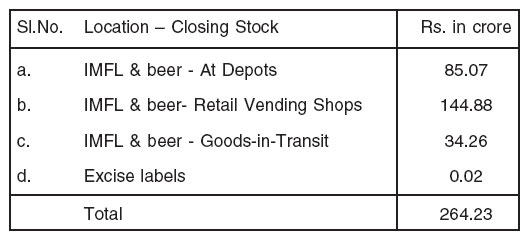
Vend fee included in the ‘goods in transit’ is Rs. 2.84 crore and
vend fee included in the closing stock at depots and at retail
vending shops is Rs. 19.06 crore.
9. The cost elements considered for valuation of inventory are:
(i) Basic price paid to manufacturer (net of trade discount)
which also includes transport charges.
(ii) Excise duty paid by the manufacturer.
(iii) Sales tax paid by the manufacturer on above.
(iv) Amount incurred on transit insurance by the company.
These elements of cost are applied for valuation of inventory lying
in retail vending shops also.
Treatment of Vend Fee in the accounts
10. The company is paying vend fee on IMFS @ Rs. 142 per
case and on beer @ Rs. 36 per case at the time of issue of
indents as stated in earlier paragraphs. The said vend fee has
been charged to the profit and loss account as and when the
same has been incurred. However, at the end of the financial year
[say 31st March of every year], vend fee paid on the goods-intransit
has been treated in the accounts as ‘prepaid expenses’ on
the stand that the liability for payment of vend fee shall arise only
on the receipt of goods.
Recognition of goods-in-transit in books of account
11. The company has been recognising ‘goods-in-transit’ in the
books of account at the year-end on receipt of invoice.
B. Query
12. The querist has sought the opinion of the Expert Advisory
Committee on the following issues, considering paragraph 6 of AS
2, dealing with cost of inventories:
(a) Whether the vend fee (which is paid out of the profit)
and the transport cost [including loading and unloading]
incurred by the company for moving the goods from depots to retail vending shops can be included in the
term ‘cost of purchase’ or ‘other costs incurred in bringing
the inventories to their present location and condition’
and be taken as an element of cost for the purpose of
valuation of closing stock both at depots and retail shops.
In case of inclusion of the vend fee as an element of
cost in valuing the closing stock, what would be the
accounting treatment in the year in which it is
implemented [i.e., measurement and impact of such cost
on the opening stock]?
(b) For the year 2006-07, the Accountant General during
the supplementary audit of accounts under section 619(4)
of the Companies Act, 1956 objected to the treatment
of ‘prepaid expenses’ for the vend fee incurred on the
goods-in-transit and the company has revised its
accounts by charging these expenses to profit and loss
account disclosing the fact and also with a specific
mention that this will be referred to the Institute of
Chartered Accountants of India (ICAI) for expert opinion.
What would be the correct treatment in accounts with
regard to recognition of ‘goods-in-transit’, and the vend
fee paid on such goods-in-transit?
C. Points considered by the Committee
13. The Committee while answering the query has addressed
only the issues raised in paragraph 12 above and has not touched
upon any other issue arising from the Facts of the Case, such as,
appropriateness of the accounting policy of the company with
respect to valuation of closing stock at lower of cost or market
price, etc.
14. The Committee notes the following paragraphs from AS 2:
“6. The cost of inventories should comprise all costs of
purchase, costs of conversion and other costs incurred
in bringing the inventories to their present location and
condition.
Costs of Purchase
7. The costs of purchase consist of the purchase price
including duties and taxes (other than those subsequently
recoverable by the enterprise from the taxing authorities),
freight inwards and other expenditure directly attributable to
the acquisition. Trade discounts, rebates, duty drawbacks and
other similar items are deducted in determining the costs of
purchase.
Costs of Conversion
8. The costs of conversion of inventories include costs
directly related to the units of production, such as direct labour.
They also include a systematic allocation of fixed and variable
production overheads that are incurred in converting materials
into finished goods…”
“11. Other costs are included in the cost of inventories only
to the extent that they are incurred in bringing the inventories
to their present location and condition. For example, it may be
appropriate to include overheads other than production
overheads or the costs of designing products for specific
customers in the cost of inventories.”
“13. In determining the cost of inventories in accordance with
paragraph 6, it is appropriate to exclude certain costs and
recognise them as expenses in the period in which they are
incurred. Examples of such costs are:
(a) abnormal amounts of wasted materials, labour, or other
production costs;
(b) storage costs, unless those costs are necessary in the
production process prior to a further production stage;
(c) administrative overheads that do not contribute to
bringing the inventories to their present location and
condition; and
(d) selling and distribution costs.”
15. From the above, the Committee notes that as per AS 2, the
cost of inventories would include costs, apart from the cost of
purchase and cost of conversion, that are incurred in bringing the
inventories to their present location and condition. The Committee
is of the view that the test for determining whether or not the cost
of carrying out a particular activity should be included in the cost
of inventories is whether the activity contributes to bringing the
inventories to their present location and condition; the nomenclature
of the activity or the place where the activity is carried out is not
relevant.
16. The Committee is of the view that the term ‘distribution costs’
referred to in paragraph 13(d) of AS 2 reproduced above read with
paragraph 6 of AS 2, should be construed as distribution costs
which are incurred by the seller in making the goods available to
the buyer from the point of sale. In other words, distribution costs
used in the expression ‘selling and distribution costs’ would include
only those costs which are incurred for moving the goods from the
premises of the seller, whether from the branches or depots or
retail outlets to the premises of the buyer. Thus, the costs incurred
in moving the goods from the manufacturers’/ suppliers’ factory to
depots or from depots to seller’s retail outlets before sale, should
be construed as the costs incurred in bringing the inventories to
their present location and condition and, therefore, should be
included as part of the cost of inventories. The Committee is
further of the view that the expenditure incurred towards loading
and unloading of the material prior to effecting the sale is also
incurred to bring the inventories to their present location and
condition and, therefore, should be considered as element of cost
of inventory. However, to the extent the transportation and loading
and unloading costs are incurred in relation to despatch to retail
vending shops, such costs should not be considered in arriving at
the cost of inventories held at depots which are meant for despatch
to retail shops. Instead, such expenditure should be considered in
arriving at the cost of inventories held at retail shops as required
by paragraph 11 read with paragraph 6 of AS 2 since this
expenditure is incurred in changing the location of the merchandise,
i.e., bringing the inventories to the intended point of sale, i.e., the
retail vending shops.
17. As far as accounting treatment of vend fee is concerned, the
Committee is of the view that the same depends on the point of
time at which vend fee is considered to be levied on the goods as
that determines the nature of the expense. In this regard, the
Committee notes section 17-D of the Tamil Nadu Prohibition Act,
1937, which provides as follows:
“17-D. Payment of a sum in consideration of the grant of
any exclusive or other privilege or fee on licences for
manufacture or sale. – The State Government may, by rules,
levy a sum or fee or both in consideration of the grant of any
exclusive or other privilege under section 17-C and also a fee
on licences granted under section 17-C.”
(Section 17-C deals with the grant of exclusive privilege of
manufacturing, or selling by retail, or supplying by wholesale of
IMFS)
The Committee further notes that Rule 15(3) of Tamil Nadu Indian
Made Foreign Spirit (Supply by Wholesale) Rules, 1983, inter alia,
states as follows:
“An additional vend fee at the rates specified below shall also
be paid by the licensee on the quantities of IMFS and Beer
sold…”
The Committee also notes from the Facts of the Case that the
vend fee is payable on the receipt of IMFS (refer paragraph 4
above) as it is required to be ‘collected’ at that stage. From the
above, the Committee is of the view that the timing of levy of vend
fee is not clear, e.g., whether it is levied on receipt or at the point
of sale. The Committee further notes that at what point the vend
fee is levied is a legal issue. Accordingly, the same is not being
addressed as the Committee is prohibited to answer issues involving
pure interpretation of the relevant enactments under Rule 2 of its
Advisory Service Rules. Accordingly, first, it should be determined
from the legal point of view as to the point of time, the vend fee is
considered to arise. The Committee is of the view that if levy of
vend fee arises on receipt of the goods, it should be treated as
part of cost of inventories. However, if levy of vend fee arises on
sale of goods, the same should not be included as part of cost of inventories, in view of the same being a selling and distribution
cost as per paragraph 13 of AS 2.
18. As far as the treatment of goods-in-transit is concerned, the
Committee notes that paragraphs 9.14 and 9.16 of the Statement
on the Amendments to Schedule VI to the Companies Act, 1956,
issued by the Institute of Chartered Accountants of India, states
as below, although in the context of disclosure of the value of
imports of raw-materials etc., to fulfill the requirements under clause
4(D)(a)of Part II of Schedule VI:
“9.14 The value of imports should include goods which are in
transit on the balance sheet date, provided that the property
in those goods has already passed to the purchasing company.
For the purpose of determining whether or not the property
has passed, reference may be made to the terms of the
import contract, and recognised legal principles, relating to
this matter...”
“9.16 Since the requirement is to disclose the value of imports
during the accounting year, it may be necessary to determine
when the title to the goods has passed from the overseas
exporter to the Indian importer. The question as to when the
title to the goods has passed should be determined in
accordance with the well recognised legal principles relating
to this matter. The disclosure should be restricted to imports
where the title has passed within the accounting year
irrespective of whether or not payment has been made during
the year and irrespective of whether or not the goods have
been physically received during the year.”
19. The Committee further notes that in the context of recognition
of revenue from sale of goods, it has been well established from
the accounting point of view that in case there has been a transfer
of significant risks and rewards of ownership in the goods, revenue
can be recognised even though transfer of property in goods has
not taken place. In this regard, the Committee notes paragraph
6.1 of Accounting Standard (AS) 9, ‘Revenue Recognition’, as
below:
“6.1 A key criterion for determining when to recognise revenue
from a transaction involving the sale of goods is that the seller
has transferred the property in the goods to the buyer for a
consideration. The transfer of property in goods, in most cases,
results in or coincides with the transfer of significant risks and
rewards of ownership to the buyer. However, there may be
situations where transfer of property in goods does not coincide
with the transfer of significant risks and rewards of ownership.
Revenue in such situations is recognised at the time of transfer
of significant risks and rewards of ownership to the buyer.
Such cases may arise where delivery has been delayed
through the fault of either the buyer or the seller and the
goods are at the risk of the party at fault as regards any loss
which might not have occurred but for such fault. Further,
sometimes the parties may agree that the risk will pass at a
time different from the time when ownership passes.”(Emphasis supplied by the Committee.)
20. The Committee is of the view that the abovementioned
requirements recognise the primacy of substance over form which
should also be applied in case of purchases. Thus, the company
should recognise only those goods-in-transit in respect of which
significant risks and rewards of ownership have passed to the
company. The Committee is of the view that the question when
the transfer of significant risks and rewards of ownership takes
place depends on particular facts and circumstances of the case,
including the terms of the contract, express and/or implied, and
the conduct of the parties. In this regard, the Committee notes that
the querist has stated in the Facts of the Case that the cost of
transit insurance is borne by the company and that the stocks
received in good and perfect condition shall only be accepted and
payment made for. The Committee is of the view that apart from
these two factors, various other factors should also be considered
for ascertaining the timing of passing of significant risks and rewards
of ownership. For example, factors, like whether the company can
sell the goods to another party or pledge the same while these are
in transit, etc. will have to be taken into account in determining the
timing of transfer of significant risks and rewards of ownership.
21. As far as accounting treatment of vend fee paid on the goodsin-
transit is concerned, keeping in view the recommendations
contained in paragraph 17 above, it would not be considered as a
‘prepaid expense’ if the risks and rewards of ownership are passed
on to the company when the goods are in transit since it would be
considered as ‘constructive receipt’ if the point of levy of vend fee
is at the point of receipt of goods. However, if the levy of vend fee
is at the point of sale, it should be considered as prepaid expense.
D. Opinion
22. On the basis of the above, the Committee is of the following
opinion on the issues raised in paragraph 12 above:
(a) The transport cost (including loading and unloading cost)
incurred by the company form part of ‘other costs
incurred in bringing the inventories to their present
location and condition’ and should be taken as an
element of cost of inventory. However, to the extent
transportation and loading and unloading costs are
incurred in relation to despatch to retail vending shops,
such costs should not be considered in arriving at the
cost of inventories held at depots which are meant for
despatch to retail shops. Instead, such cost should be
considered in arriving at the cost of inventories held at
retail shops as discussed in paragraph 16 above. The
vend fee should be included in the cost of inventories
only when the levy of the fee is considered to arise at
the point of receipt of goods as discussed in paragraph
17 above. In such a case, the vend fee not included in
the opening stock should be considered as a ‘prior period
item’ under Accounting Standard (AS) 5, ‘Net Profit or
Loss for the Period, Prior Period Items and Changes in
Accounting Policies’ and treated accordingly.
(b) The goods-in-transit would be recognised as the
inventories of the company depending on whether the
significant risks and rewards of ownership of these goods
have been transferred to the company considering the
factors discussed in paragraph 20 above. As far as
vend fee paid on such goods-in-transit is concerned, it should be included as a part of cost of inventory only
when the liability in respect thereof arises as discussed
in paragraph 21 above.
|