|
A. Facts of the Case
1. A company, incorporated under the Companies Act, 1956, is
a 50:50 Joint Venture of company ‘N’ Ltd. and the State Electricity
Board. The company is establishing a coal based thermal power
project of 1,500 MW comprising 3 x 500 MW Units in the State.
The company, being an electricity generating company, is governed
by the provisions of the Electricity Act, 2003. As per the querist,
since the Government has not prescribed any statement of accounts for the central undertakings engaged in generation of electricity,
the company is preparing its accounts in the format prescribed as
per Schedule VI to the Companies Act, 1956.
2. The company awarded two contracts to M/s A Ltd. for supply
and erection of steam generators with electrostatic precipitator
and turbine generator. The contract value has components in US
Dollars, Euro and Indian Rupees. The break-up of the contract
price is as under:
Steam Generator Package
Supply of Plant & Equipment USD 49,035,900
Euro 22,799,250
INR 7,025,450,120
Supply of Mandatory Spares INR 453,151,152
Type Test Charges INR 16,339,535
Total USD 49,035,900
Euro 22,799,250
INR 7,494,940,807
Turbine Generator Package
Supply of Plant & Equipment USD 19,646,260
Euro 38,516,440
INR 4,105,081,301
Supply of Mandatory Spares INR 297,251,399
Type Test Charges INR 11,574,027
Total USD 19,646,260
Euro 38,516,440
INR 4,413,906,727
3. The terms of payment for the supply of the equipment are as
under:
1. Initial advance 15% of contract value
2. On despatch 55% of the contract value
3. On receipt 20% of the contract value
4. On trial operation 05% of contract value
5. On performance test
10% of contract value
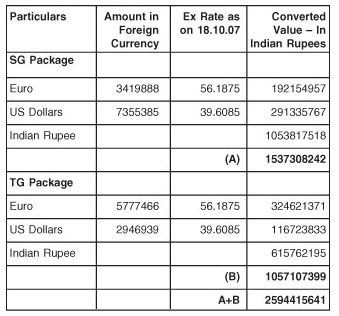
M/s A Ltd. will supply the equipments over a period of two to three
years. During the year 2007-08, the company has paid 15% of the
contract value as initial advance to M/s A Ltd. as per the terms of
the contract on 18th October, 2007:
4. The above-mentioned amount of advance was accounted for
as ‘Advance for Capital Expenditure’ and grouped under the head
‘Fixed Assets – Construction Stores & Advances’ in the annual
accounts of the company for the financial year 2007-08. The
company did not restate the amount of advances at the rates of exchange ruling as at the balance sheet date, i.e., 31st March,
2008.
5. During supplementary audit of accounts u/s 619(3) of the
Companies Act, 1956 by the Comptroller & Auditor General of
India, it was observed by them that the advances paid for capital
expenditure in foreign currency are monetary items as per
Accounting Standard (AS) 11, ‘The Effects of Changes in Foreign
Exchange Rates’, and should have been reported at the exchange
rates prevailing as on 31.03.2008 (reporting date), i.e., US Dollars
= Rs. 39.49 and Euro = Rs. 62.34 and the corresponding exchange
gain of Rs. 5.54 crore should have been credited to the profit and
loss account/‘Incidental Expenditure During Construction’ account.
6. During discussions with the Government Auditors, the statutory
auditors of the company were of the view that advance for capital
expenditure in foreign currency is to be treated as a non-monetary
item considering the following:
(i) As per the definition given in AS 11, monetary items are
money held and assets and liabilities to be received or
paid in fixed or determinable amounts of money, e.g.,
cash, receivables and payables.
(ii) As per International Accounting Standard (IAS) 21, The
Effects of Changes in Foreign Exchange Rates, the
essential feature of a monetary item is a right to receive
(or an obligation to deliver) a fixed or determinable
number of units of currency. Conversely, the essential
feature of a non-monetary item is the absence of a right
to receive (or an obligation to deliver) a fixed or
determinable number of units of currency.
(iii) In the instant case, the capital advance is not to be
received back in cash; rather, only a capital asset will
be received against the same. Hence, it is a nonmonetary
item as per the definition of AS 11.
(iv) The intention of AS 11 is to recognise that portion of
gain/loss of the change in foreign currency rates arising
on subsequent payments/receipts, which pertains to the relevant accounting period (i.e., the monetary assets/
liabilities are restated at year-end rates to recognise the
gain/loss which has arisen in that accounting period).
Since no gain/loss is going to arise on receipt of the
asset at a later date, there is no question of recognising
the portion of gain/loss which has arisen up to the yearend
date. Any gain/loss on change in foreign currency
rates would arise only when the advance is received
back in cash whereas the financial statements are
prepared with the assumption that only an asset would
be received against the capital advance. Hence, restating
the capital advance at the year-end rates would only
lead to a notional entry which would be required to be
reversed in the subsequent period.
After deliberations, Government Auditors observed that the
observation regarding treatment of advances for capital expenditure
lacks clarity and should be referred to the Expert Advisory
Committee of the Institute of Chartered Accountants of India for
opinion.
B. Query
7. Considering the above, the querist has sought the opinion of
the Expert Advisory Committee on the following issues:
(i) Whether advance paid to M/s A Ltd. for acquisition of
fixed assets is a monetary item.
(ii) If answer to (i) above is in the affirmative, whether the
advances paid to a party for acquisition of fixed assets
are to be restated by using the closing rate of exchange
at each balance sheet date.
(iii) In case answer to (ii) above is in the affirmative, whether
these exchange differences can be adjusted in the cost
of related assets, considering the provisions of paragraph
9.1 of Accounting Standard (AS) 10, ‘Accounting for
Fixed Assets’, i.e., directly attributable cost of bringing
the asset to its working condition for its intended use.
C. Points considered by the Committee
8. The Committee notes that the basic issue raised by the querist
relates to treatment of advance paid in foreign currency. Therefore,
the Committee has examined only this issue and has not examined
any other issue that may be contained in the Facts of the Case.
Further, the Committee notes that the foreign currency advance
was paid on 18.10.2007 (i.e., during the accounting year 2007-
08). Hence, Accounting Standard (AS) 11, ‘The Effects of Changes
in Foreign Exchange Rates’, notified under the Companies
(Accounting Standards) Rules, 2006 (the ‘Rules’) is applicable for
the Facts of the Case. Incidentally, the Committee notes that the
total of payments payable at different stages mentioned in
paragraph 3 above exceeds 100% of contract price. However, this
does not affect the issue involved.
9. The Committee notes the following paragraphs from AS 11
notified under the ‘Rules’:
“7.11 Monetary items are money held and assets and
liabilities to be received or paid in fixed or determinable
amounts of money.”
“7.14 Non-monetary items are assets and liabilities
other than monetary items.”
“12. Cash, receivables, and payables are examples of
monetary items. Fixed assets, inventories, and investments in
equity shares are examples of non-monetary items. …”
10. From the above, the Committee is of the view that the words
‘received or paid’ in the definition of the term ‘monetary items’ do
not necessarily envisage receipt or payment in cash. What is of
the essence of the definition of monetary items is that the value of
the asset or liability should be fixed or determinable in monetary
terms. Accordingly, where the advance is related to a fixed price
contract for the receipt of a specified quantity of goods, it will be a
non-monetary asset since it represents a claim to receive a specified
quantity of goods and not a right to receive money. From the
Facts of the Case, the quantity of the fixed assets to be received
is specified and the price expressed in multi-currency is also fixed.
It is a case of fixed price contract for the receipt of a specified
quantity of fixed assets. Hence, the Committee is of the view that,
in the present case, foreign currency component of advance paid
which is related to the fixed assets to be received is a non-monetary
item.
D. Opinion
11. On the basis of the above, the Committee is of the following
opinion on the issues raised by the querist in paragraph 7 above:
(i) No. Advance paid to M/s A Ltd. for acquisition of fixed
assets is not a monetary item. It is a non-monetary
item.
(ii) In view of (i) above, this question does not arise.
(iii) In view of (ii) above, this question does not arise.
|