|
A. Facts of the Case
1. A public sector company is manufacturing industrial chemicals
and fertilizers. In the manufacture of the same, it uses many
inputs as well as catalysts. As per design, catalysts are directly
used in the production process to facilitate reaction. As these
catalysts do not participate in the reaction these are classified as
process chemicals and consumables rather than raw material
inputs. Catalysts are of high value. Such catalysts are replaced
when their charge gets over or does not support the performance as desired. The company uses various catalysts in its production
which is product/plant specific. The charge of some of the catalysts,
normally called as the life of the catalyst, may be over in one year
whereas sometimes it gets extended up to 5-7 years. The first
charge of the catalyst is capitalised along with the plant.
2. The company prepares annual cost statements based on
absorption costing method for valuation of its stock of finished
products. As the expected life/utility of catalyst exceeds over a
year there is a scope for consideration of pro-rata cost of catalyst
based on its expected life while arriving at the cost of production
of the finished product. However, since inception, consistently the
company charges off the entire cost of catalyst replaced in the
year of its replacement. The reasons for the same are as under:
(i) The expected life is subject to innumerable and dynamic
variables of continuously running plants and material
conditions. Thus, there is no standard input-output
relationship between expected life and the quantity of
catalyst consumed.
(ii) The company has experienced erratic fluctuations in
the actual life as compared to its estimated life in all
cases.
(iii) Moreover, in every annual shutdown, the catalysts are
reviewed and some of the catalysts are topped-up, i.e.,
part replacement is done to support performance. Hence,
the company is also required to maintain inventory of
such catalysts to meet operating requirements.
(iv) Catalysts are product/plant specific, thus forming part
of direct cost of production.
(v) Once a catalyst has become completely useless, it is
disposed off as scrap.
(vi) Pro-rata charging off the cost of catalyst requires bringing
back to inventory, the quantity of catalysts already issued
to process which is highly unascertainable and
impractical.
3. The querist has informed that the company has adequately
disclosed the fact in its accounting policy in this regard as follows:
“cost of manufactured goods comprises of direct cost (including
cost of catalyst replaced during the year), variable production
overheads and fixed production overheads on absorption
costing method”.
The querist has also informed that the company’s accounting policy
also states that “the company does not value stocks in process at
the close of the year as the same is not practicable”.
4. During the year 2007-08, the Government auditors have
queried that this practice is not as per paragraph 8 of Accounting
Standard (AS) 2, ‘Valuation of Inventories’, since the company is
charging off the entire cost of catalyst in the year in which it is
incurred even though the life of the catalyst is four years. This is
resulting in abnormal expense during the first year of replacement
of catalyst. Paragraph 8 of AS 2 relates to treatment of cost of
conversion. During the year 2007-08, the company incurred a cost
of Rs. 24.71 crore for the replacement of catalyst in its ammonia
plant and has charged off the same in the accounts of the year
without spreading over the cost of catalyst for four years. This has
resulted in overstatement of finished goods (urea) and material
consumed to the extent of Rs. 1.75 crore and Rs. 18.53 crore
respectively, and understatement of profit to the extent of Rs.
16.78 crore.
5. To the above observation of the Government auditors, the
company replied that as the usage of the catalyst in production
process is not systematic, the company has been charging off the
cost of the catalyst in the year of replacement itself. The company
also argued that the expected life of the catalyst as arrived at by
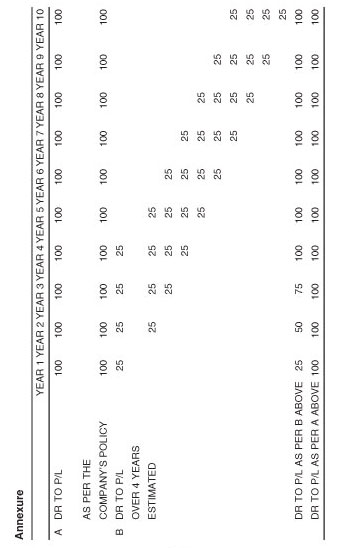
the auditors is notional. Further, as explained in Annexure I by the
querist, any other method followed would result in the same charge
to the profit and loss account.
6. The Government auditors have cleared the accounts only on
the assurance that an expert opinion on this accounting treatment
would be obtained from the Institute of Chartered Accountants of
India.
B. Query
7. The querist has sought the opinion of the Expert Advisory
Committee on the following issues arising from the above facts:
(i) Whether the company is correct in its accounting
treatment for catalysts.
(ii) Whether the current practice of the company is contrary
to paragraph 8 of AS 2.
C. Points considered by the Committee
8. The Committee, while expressing its opinion, has restricted
itself to the issues raised with regard to accounting for catalyst as
stated in paragraph 7 above and has not considered any other
issue that may raise from the Facts of the Case, such as, the
accounting policy of the company regarding not valuing the stockin-
process at the close of the year.
9. The Committee notes from the Facts of the Case that the
catalysts having high values are used in the production process.
The catalysts have a life more than one year although the life may
fluctuate considerably keeping in view the conditions in which the
same is used. Further, a catalyst may be reused after recharging
the same. Once a catalyst becomes completely useless it is
disposed off as scrap.
10. The Committee notes that a catalyst meets the definition of
an asset since it is a resource controlled by the enterprise from
which its future economic benefits are expected to flow to the
enterprise. Unless the amount of an asset is not material, it is
necessary to determine the nature of the asset in order to determine
its appropriate accounting. Keeping in view the nature of the
catalyst, the Committee is of the view that the catalysts can either
be inventories or fixed assets. In this context, the Committee notes
the definition of ‘fixed asset’ given in paragraph 6.1 of Accounting
Standard (AS) 10 ‘Accounting for Fixed Assets’, as below:
“6.1 Fixed asset is an asset held with the intention of being
used for the purpose of producing or providing goods or
services and is not held for sale in the normal course of
business.”
The Committee also notes the definition of ‘inventories’ given in
paragraph 3 of AS 2, as follows:
“Inventories are assets:
(a) held for sale in the ordinary course of business;
(b) in the process of production for such sale; or
(c) in the form of materials or supplies to be consumed
in the production process or in the rendering of
services.
11. The Committee notes from the Facts of the Case that a catalyst
only facilitates the process of production of a product. Without the
catalyst plant and machinery can still operate and the product can
still be produced. Accordingly, catalyst cannot be considered of
the nature of plant and machinery, which converts raw materials
into finished products. The catalyst is also not of the nature of an
asset which is kept for administrative use. Accordingly, the
Committee is of the view that the catalyst is not of the nature of a
fixed asset as contemplated in AS 10. On the other hand, the
Committee is of the view that the catalyst is used in the process of
production and is of the nature of supply to be consumed in the
production process. It should be considered of the nature of a
consumable even though its life may be greater than one year. In
other words, the Committee is of the view that a catalyst is covered
by the definition of the term ‘inventories’ under AS 2. Accordingly,
in the view of the Committee, the principles of AS 2 should be
applied for the purpose of measurement and presentation of
catalysts. Keeping in view the above considerations, the Committee
is of the view that the first charge of the catalyst should not be
capitalised along with the plant as being presently done by the
company.
12. From the above, the Committee is of the view that catalysts
should be valued at the lower of cost and net realisable value as
prescribed in paragraph 5 of AS 2. At the end of the year, where
the catalysts are still in use, the cost thereof to be charged under
cost of conversion as per paragraph 8 of AS 2 should be only to
the extent of catalysts consumed during the period. To the extent
the catalyst is yet to be consumed, it should be treated as inventory, for whose valuation purposes, the balance cost of the catalysts
should be compared with the net realisable value thereof. With
regard to determination of net realisable value, the Committee is
of the view that paragraph 24 of AS 2 reproduced below should be
applied:
“24. Materials and other supplies held for use in the production
of inventories are not written down below cost if the finished
products in which they will be incorporated are expected to be
sold at or above cost. However, when there has been a decline
in the price of materials and it is estimated that the cost of the
finished products will exceed net realisable value, the materials
are written down to net realisable value. In such circumstances,
the replacement cost of the materials may be the best available
measure of their net realisiable value.”
Accordingly, the Committee is of the view that the accounting
policy of the company in respect of catalyst would be correct if the
net realisable value thereof, as determined above, is nil.
D. Opinion
13. On the basis of the above, the Committee is of the following
opinion on the issues raised by the querist in paragraph 7 above:
(i) The company would be correct in its accounting treatment for
catalysts if the net realisable value as determined in accordance
with paragraph 12 above is nil.
(ii) The current practice of the company is contrary to paragraph
8 of AS 2.
|