Query No. 15 Subject: Accounting for common fixed assets constructed for a project under progress.1 A. Facts of the Case
1.A Government of India company (hereinafter referred to as ‘the company’) is engaged in the construction and operation of thermal power plants in the country. The company has also diversified into hydro power generation, coal mining and oil and gas exploration, etc. The company is registered under the Companies Act, 1956 and being an electricity generating company, is governed by the provisions of the Electricity Act, 2003. The company prepares its annual financial statements as per the provisions of the Companies Act, 1956. The company is also listed with the Bombay Stock Exchange and the National Stock Exchange.
2.The querist has stated that the company is involved in the construction of power projects. Every project has a defined capacity expressed in terms of Megawatts (MWs) and such capacity is further divided into stages and units. The company envisages construction of power projects that are around 1000/1320/2000/3000 MW in capacity. These normally consist of individual generating units of 500/660 MW capacity. The capacities are built in clusters called stages. Generally, each stage may consist of 2 or more units and the power projects are constructed in phased manner. For example, let us take a project of 3000 MW capacity which is being constructed. To generate 3000 MW electricity, 6 generating units of 500 MW each are being constructed, thus, making the total envisaged capacity of 500 MW x 6 = 3000 MW. This capacity is further divided into three stages of 1000 MW each. In the first phase of the project, Stage I of 1000 MW (two units of 500 MW each) capacity shall be installed and commissioned. The other two stages shall follow the Stage I. Within the stage also, the units are scheduled to be commissioned on different dates as per the construction schedule. For example, the first unit may be commissioned in the month of May and the second unit in the month of December of a particular year. There is generally a minimum time gap of around 4 to 6 months in the dates of the commissioning of two units of a stage.
3. Each generating unit consists of various systems, like Steam Generator, Turbine Generator, Coal Handling Plant, Ash Handling Plant, Circulating Water System, Merry Go Round (MGR) Track and Signalling System, Water Treatment Plant, Switchyard, etc. In the above systems, Coal Handling Plant, Ash Handling Plant, Circulating Water System, MGR Track and Signalling System, Water Treatment Plant, Switchyard, etc. are not specific for a particular generating unit but cater to the two units of first stage of the project.
4. In coal based thermal power plants, coal is the basic fuel which is used in the process of generation of electricity. To cater to the coal requirement of a generating unit, a coal handling plant comprising track hopper, crusher house, conveyor and coal stock yard is constructed. Through the coal handling system, coal is supplied to the two different generating units of the first stage of the project.
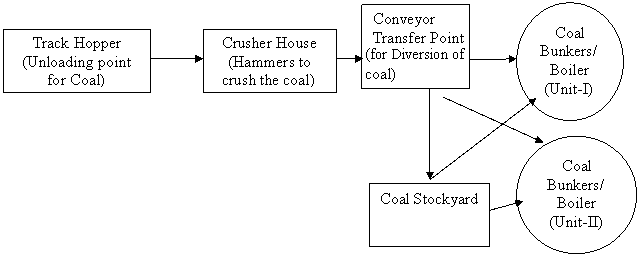
5. The structure of a typical coal handling system of generating units catering to two units of a stage is given below for understanding the movement of coal from track hopper (delivery point of coal by Railways) to the boiler (where coal is burnt) can be understood with the help of the following diagram:
Note:-----> Arrows in the above diagram are represented by Conveyor Belt System
Normally, fuel requirements of a thermal power project are linked to a particular coal mine and the coal is supplied through the company’s own merry go round system or railway wagons. Coal is unloaded at the project at the track hoppers and then the coal moves to the crusher house through conveyors. In the crusher house, the coal is crushed and then it moves to the coal bunkers/boiler or to the coal stockyard as the case may be. In case, coal supply at any time from the coal mine is less, coal is reclaimed from the coal stockyard and transported to the coal bunkers/boiler. From the boiler bunkers, the coal is used in the generating unit boilers to generate the electricity. A boiler bunker is separate for each of the generating unit.
6. The querist has stated that generally, for the construction of coal handling system for two generating units of a stage, a single contract is awarded. The total package includes (a) construction of coal handling plant including the conveyor system and the mechanical structures and (b) construction of separate coal supply arrangements beyond the crusher house to different generating units of the project. Thus, the coal handling plant is a common system catering to all generating units of the 1st stage of the power project.
7. The querist has reproduced paragraph 10.1 of Accounting Standard (AS) 10, ‘Accounting for Fixed Assets’, notified under the Companies (Accounting Standards) Rules, 2006 (hereinafter referred to as ‘the Rules’), which deals with the capitalisation of self-constructed fixed assets as under:
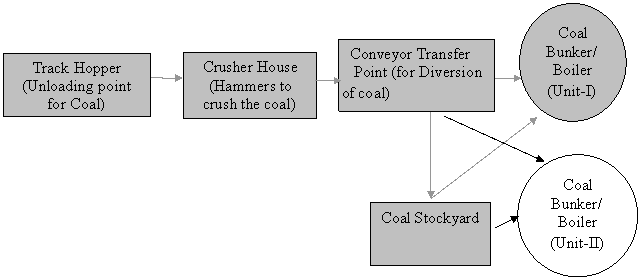
8. According to the querist, in line with the above requirements, on commercial declaration of the first unit of Stage I of the project, the cost of systems which have started functioning (including the cost of the coal handling plant) is to be capitalised along-with the cost of first unit. As the cost of the portion of coal handling plant declared commercial is not directly available, the cost of coal handling system is technically estimated/assessed by a committee comprising members from Engineering, Finance and Erection Department of the project. Based on such technical assessment, the cost of coal handling system put into commercial declaration along-with Unit I is capitalised along-with the cost of Unit I. The portion of the coal handling system capitalised along-with Unit I has been marked with shade in the following diagram. The cost of conveyor system from ‘Conveyor Transfer Point’ to ‘Boiler (Unit II)’ and from ‘Coal Stockyard’ to ‘Boiler (Unit II)’ shall be capitalised along-with the cost of Unit II of Stage I based on engineering estimates/assessments.
Note:------> Arrows in the above diagram are represented by Conveyor Belt System
The querist has further clarified that the coal handling system is available for use of Unit I. Pending Unit II being ready for commercial operation, the cost of entire coal handling system except Conveyor system from ‘Conveyor Transfer Point’ to ‘Boiler (Unit II)’ and from 'Coal Stockyard’ to ‘Boiler (Unit II)’ is being capitalised along-with Unit I. The aforesaid cost of conveyor system relating to Unit II will be capitalised along-with Unit II when it would be ready for commercial operation. The querist has also clarified that when Unit-I of the project is available for commercial generation, all systems which are common to both the units, e.g. Steam Generator, Turbine Generator, Coal Handling System, Ash Handling System, C&I System shall be capitalised as separate assets. To arrive at the capitalisation value of the coal handling plant, an engineering estimate for the work done relating to Unit-I (the shaded portion in the diagram) is ascertained by a committee comprising members from Engineering, Finance and Erection Department of the project. The estimate is made based on the work executed for Unit-I and corresponding item-wise rates given in the contract.
9. The querist has also explained by way of an example: suppose the whole of the coal handling system covered in the scope of the contract is for Rs. 10 crore and the value of the completed portion of the ‘Coal Handling System’ available for use for starting generation by Unit - I is Rs. 8.5 crore. The amount of Rs. 8.5 crore towards the Coal Handling System (shaded portion in the diagram) shall be capitalised as a separate asset at the time of capitalisation of other systems of Unit - I. Remaining value, i.e., value of the non-shaded portion under construction will continue to be shown in capital work-in-progress till such works are completed. On completion of other systems of Unit-II, Rs. 1.50 crore will be capitalised as a separate asset along-with other systems of Unit-II.
10. The company has also adopted the following accounting policy with regard to capitalisation of common assets and systems:
B. Query
11. On the facts and circumstances stated above, opinion of the Expert Advisory Committee has been sought by the querist on the following issues:
C. Points considered by the Committee
12.The Committee notes that the basic issue raised in the query relates to capitalisation of the expenditure incurred on construction of coal handling plant/system for making it operational for use of Unit I at the time of commercial declaration of Unit I. The Committee has, therefore, considered only this issue and has not considered any other issue that may arise from the Facts of the Case, such as, propriety of capitalisation of the remaining portion of the expenditure on coal handling plant (viz., which is specifically related to Unit II) as a separate asset, capitalisation of other common assets and systems, such as, Steam Generator, Ash Handling Plant, Circulating Water System, MGR Track and Signalling System, Water Treatment Plant, Switchyard, etc. The Committee has presumed that in the extant case, the term ‘declared commercial’ has been used to indicate that the plant/system, as the case may be, is ready to commence commercial production.
13.The Committee notes paragraphs 9.1, 9.2 and 10.1 of AS 10, notified under the Companies (Accounting Standards) Rules, 2006 (hereinafter referred to as the ‘Rules’), which provide as follows:
The cost of a fixed asset may undergo changes subsequent to its acquisition or construction on account of exchange fluctuations, price adjustments, changes in duties or similar factors.
From the above, the Committee notes that the basic principle to be applied while capitalising an item of cost as a part of the cost of a fixed asset is that it should be directly attributable to the construction of the fixed asset for bringing it to its working condition for its intended use. The Committee notes from the Facts of the Case that the coal handling plant handles and processes the fuel required for operation of the generating units (Unit I and Unit II). Thus, in the extant case, the Committee is of the view that power generating units (Unit I and Unit II) and coal handling system can be considered as composite plant, which would be ready for its intended use only when either Unit I or Unit II and the coal handling system, to the extent related to the relevant unit, are ready for commercial production. The issue as to point of time when part of a composite plant should be capitalised has been addressed in paragraphs 21 and 22 of Accounting Standard (AS) 16, ‘Borrowing Costs’, notified under the ‘Rules’, although from the point of view of the borrowing costs only. The Committee is of the view that the principle enunciated in these paragraphs can be applied to other expenditures also. Paragraphs 21 and 22 of AS 16 are reproduced below:
From the above, the Committee is of the view that those parts of the composite plant which are ready for their intended use and can be operated independently of the remaining parts, should be considered to be ready for commencement of commercial production/intended use. Accordingly, in the extant case, coal handling system although under construction but since substantially complete, such that Unit I is ready to commence commercial production, it would be correct to capitalise that cost of the coal handling plant which is necessary for making Unit I operational when Unit I is ready to commence commercial production.
14.As regards using technical estimates for determining the cost of the related portion of coal handling plant which is to be capitalised, the Committee is of the view that technical estimates can be used provided these approximate the cost of such system reliably.
D. Opinion
15. On the basis of the above, the Committee is of the following opinion on the issues raised in paragraph 11 above:
_________________________ |
|||