|
Query No. 10
Subject: Inclusion of various costs in the valuation of inventories.
A. Facts of the Case
1. A navaratna public sector undertaking (PSU) (hereinafter referred to as the ‘company’) under the administrative control of the Ministry of Petroleum and Natural Gas is engaged in exploration, production and transportation of crude oil and natural gas, production and sale of liquid petroleum gas (LPG) and condensate and transportation of finished petroleum products of other PSU refineries to their marketing points. Presently, the company sells its entire crude oil to PSU refineries. The transfer of crude oil to the refineries takes place after testing and determination of quality (base sediment and water determination) and quantity of crude oil at the refinery gate through the process pipeline owned by the company and the requisite documentations are prepared and authenticated jointly by the representatives of the company and the respective refineries. Sales take place at the refinery gate with the passing of risks and rewards to the refineries. Revenue is only recognised at the refinery gate, i.e., at the custody transfer point. Extract of the relevant portion of the company’s accounting policy has been stated below:
“Revenue Recognition: Revenue from sale of products is recognised on custody transfer to customers.”
2. It may be noted that in the process of delivery of crude oil through its pipeline, there has always been certain amount of finished crude oil remaining in the operational process namely at tank farm and pipeline before the transfer takes place at the custody transfer point. The broad operational process flow diagram for this is as under:
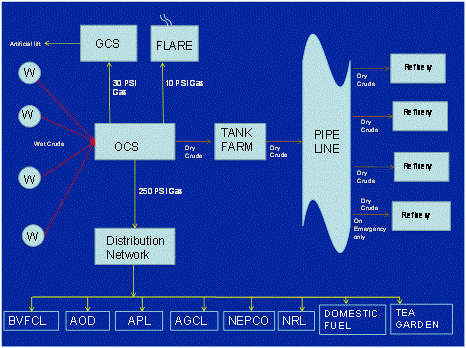
The querist has separately explained with reference to flow diagram as follows:

Indicates producing wells. Producing wells located in the fields are used for lifting the crude oil upto surface level (i.e., well head).
OCS stands for Oil Collecting Stations. After lifting, crude oil is transported through flow lines from the well head to the connected Oil Collecting Stations for further processing.
In OCS, separation of formation water, associated natural gas, etc. are carried out. After separation, crude oil is stored in storage tanks for onward despatch to tank farm. Gas separated at the OCS is:
(i) transported through fields net work line to GCS (Gas Collecting Stations) which is used further for injection into the well bore for lifting of crude oil (which is called Artificial Lifting Technique).
(ii) transported through fields net work line to distribution network for onward distribution to various consumers of natural gas.
(iii) Low pressure gas which is otherwise not required is flared.
Dry crude (separated from water and associated natural gas) is transported from OCS through flow lines to the connected tank farm.
From the storage tanks, the crude oil which contains formation water is despatched to tank farms, where it is processed for further separation of formation water by gravity separation process as in Central Tank Farm (CTF) or is routed through dehydration facilities like Electrostatic Emulsion Treater (EET) in Intermediate Tank Farm (ITF). In gravity separation process, the crude once received in the tanks is allowed to settle for a retention time of ideally 10-12 hours for free water and sludge to settle.
The processed crude oil at tank farm level is then handed over to pipeline department through custody transfer for onward despatch to refineries.
Pipeline functions though its various pumping stations. Crude oil from tank farm is handed over to pipeline department which is pumped to pump stations nearer the central tank farm. On receiving, pump stations pump it further to the next forward pump stations on its way to the custody transfer point before the refinery gate.
3. Crude oil remaining in the operational process as stated above before its transfer of risks and rewards to the refineries at the custody transfer point is required to be valued at the end of a given financial period. Cost of finished goods is determined on absorption costing method. Relevant portion of the accounting policy of the company is as under:
“Finished goods of Crude Oil, Liquified Petroleum Gas and LPG Condensate are valued at cost or net realisable value, whichever is lower. Cost of finished goods is determined on absorption costing method.” (Emphasis supplied by the querist.)
Accordingly, quantities of finished crude oil stock lying in the process namely at tank farm and pipeline at the end of a given financial period are valued at lower of cost or net realisable value as per the above accounting policy as well as Accounting Standard (AS) 2, ‘Valuation of Inventories’.
4. With regard to the absorption costing method followed by the company, the querist has also clarified that in the method, the fixed production costs for a period are shared across the output for that period. In an extractive industry like oil and gas, where the company produces crude oil from the wells located in blocks owned by it, there is no variable cost of production except royalty which is payable on production (royalty varies with the quantity of crude oil produced). Fixed production cost normally comprises the actual cost incurred during a period towards:
(i) Salary and wages of manpower engaged in operation and maintenance of wells and production installations (OCS), well servicing and work over operations, wellhead setup, tank farm, etc.
(ii) Stores and consumables like chemical, flow improver, industrial gases, etc.
(iii) Cost of any hired services for maintenance, casual labour, vehicles, equipments, etc.
(iv) Insurance premium on assets like building, plant and machineries installed at OCS, crude oil flow lines.
(v) Fuel and lube oil used for plant and machineries.
(vi) Captive consumption of gas etc. for injection.
(vii) Depreciation of plant and machineries and depletion of producing fields.
(viii) Share of engineering and general services departments like water, electricity, transport, administration, finance and accounts, security, safety and environment, township etc. (all services relating to fields operational area). Total of actual cost of service departments are apportioned to production on a reasonable basis.
Sum of the actual cost incurred on (i) to (viii) above during a period is divided by the net production quantity (Gross production less unavoidable losses) during that period to calculate the per unit cost of production (excluding royalty) under absorption costing method.
Note: Costs do not include corporate / general administrative expenditure.
In addition, the querist has stated that operation and maintenance cost of pipelines towards salary and wages, stores and consumables, cost of hired services, insurance and depreciation of pipelines and other plants and machineries etc., cost of apportioned services and overhead cost on actual basis of pipeline transportation activity are divided by the crude oil quantity delivered to the refineries at the custody transfer point to calculate the pipeline cost per unit.
5. The querist has stated that the cost elements considered for valuation of crude oil are cost of production, royalty charges at a rate applicable as on valuation date and other costs incurred for tank farm and pipeline, viz., depreciation/depletion, operation and maintenance cost, insurance charges. With regard to royalty charges, the querist has separately clarified as follows:
(i) Royalty is levied on crude oil, condensate and natural gas and governed by Oilfield (Regulation & Development) Act, 1948 (the ‘Act’) and Petroleum & Natural Gas Rules, 1959 (the ‘Rules’).
(ii) The liability of royalty arises to the lessee, i.e., company at the time of production and is payable to the Central/State Government who has granted the lease at the rate and time specified in the Act and the Rules.
(iii) Taxable event/base for payment of royalty is production of crude oil/natural gas/well head condensate. Royalty is not collected from or billed to the customer separately as per the pricing terms of crude oil sale agreement. It is a cost to the company and is shown as expenditure in the statement of profit and loss.
With regard to maintenance, the querist has separately clarified that it primarily comprises dewaxing the pipelines through pigging service at regular intervals depending on temperature, line pressure and crude quality. Maintenance activities of tank farm and pipelines are part of regular operational process. Further, insurance costs are incurred in respect of crude oil lying in pipelines and tanks farm as well as for pipelines and tank farms. The querist has also stated that the above other costs have been included in valuation of inventories in line with the principle enunciated in paragraph 11 of AS 2 which states as under:
“Other costs are included in the cost of inventories only to the extent that they are incurred in bringing the inventories to their present location and condition. ...” (Emphasis supplied by the querist.)
6. Further, it is to be stated that crude oil lying in the tank farm is subjected to certain operations, viz., heating and agitating on a continuous basis to retain its marketable characteristics and then the same is transmitted through the pipeline upto the custody transfer point which are the normal operational processes of the upstream oil and gas companies. As per the refinery practices, the selling point starts only at the refinery gate, i.e., the custody transfer point. These tank farm and pipelines are not used for any storage and also not technically built for continuous storage purpose. It is relevant to note that the downstream companies on receiving such crude oil keep the same in their tank farm and such crude oil is again subjected to heating and agitating process in the tank farm till it is sent for refinery process.
7. The querist has also stated that value of inventories determined as above does not also include the stipulations mentioned in paragraph 13 of AS 2, which inter alia, states as below:
“(a) abnormal amounts of wasted materials, labour, or other production costs;
(b) storage costs, unless those costs are necessary in the production process prior to a further production stage;
(c) administrative overheads that do not contribute to bringing the inventories to their present location and condition; and
(d) selling and distribution costs.”
(Emphasis supplied by the querist.)
Views of the Auditor:
8. During the audit for the financial year (F.Y.) 2012-13, the question of inclusion of royalty charges on crude oil at a rate applicable as on valuation date before the sales take place and other costs incurred on tank farm and pipeline, viz., depreciation/depletion, operation and maintenance cost and insurance in the valuation of closing finished stock of crude oil was raised. It was contended by the audit that these costs are in the nature of selling and distribution expenses. Therefore, these costs should not be included in the inventory cost.
Views of the company:
9. The company contended that the liability of royalty charges on crude oil like excise duty accrues on production of crude oil and it has been treating the tank farm and pipeline cost being part of other costs for bringing the finished crude oil to its present location and condition in line with paragraph 11 of AS 2 as mentioned above. This practice of valuation of closing stock of finished crude oil is being followed by the company consistently. The company further contended that tank farm and pipeline are part and parcel of the operational process and there is no involvement of storage and distribution activities in the said process. Moreover, the quantum and value of finished crude oil stock including the value of cost of production lying in the tank farm and pipeline before its custody transfer point are not material (less than 0.5% of turnover).
B. Query
10. In the above background, the querist has sought the opinion of the Expert Advisory Committee on the following issues:
(i) Whether the royalty charges on crude oil at a rate applicable as on valuation date and other costs of tank farm and pipeline, viz., depreciation/depletion, operation and maintenance cost and insurance charges should be included in the valuation of finished crude oil stock.
(ii) If not, then what is the correct method of valuation of finished crude oil stock before its custody transfer?
C. Points considered by the Committee
11. The Committee notes that the basic issue raised by the querist relates to inclusion of royalty charges on crude oil and other costs of tank farm and pipeline viz., depreciation/depletion, operation and maintenance cost and insurance charges in the cost of finished crude oil stock. Therefore, the Committee has examined only this issue and has not examined any other issue that may be contained in the Facts of the Case, such as, other elements of cost in the cost of inventories, allocation of fixed production cost to determine cost of production, propriety of method or cost formula used for determining cost of finished goods, applicability of paragraph 1(d) of AS 2 for valuation of producer’s inventories of mineral oils, ores and gases at net realisable value at certain stages of production, revenue recognition of crude oil, measurement of royalty charges to be included, if any, in the cost of inventories, inclusion of insurance charges of crude oil lying in the tank farm or pipeline in the cost of inventories, assessment of materiality with regard to quantum and value of finished crude oil lying in the tank farm and pipeline, etc.
12. The Committee notes the following paragraphs of Accounting Standard (AS) 2, ‘Valuation of Inventories’, notified under the Companies (Accounting Standards) Rules, 2006:
“6. The cost of inventories should comprise all costs of purchase, costs of conversion and other costs incurred in bringing the inventories to their present location and condition.
Costs of Purchase
7. The costs of purchase consist of the purchase price including duties and taxes (other than those subsequently recoverable by the enterprise from the taxing authorities), freight inwards and other expenditure directly attributable to the acquisition. Trade discounts, rebates, duty drawbacks and other similar items are deducted in determining the costs of purchase.
Costs of Conversion
8. The costs of conversion of inventories include costs directly related to the units of production, such as direct labour. They also include a systematic allocation of fixed and variable production overheads that are incurred in converting materials into finished goods. …”
“11. Other costs are included in the cost of inventories only to the extent that they are incurred in bringing the inventories to their present location and condition. For example, it may be appropriate to include overheads other than production overheads or the costs of designing products for specific customers in the cost of inventories.”
“13. In determining the cost of inventories in accordance with paragraph 6, it is appropriate to exclude certain costs and recognise them as expenses in the period in which they are incurred. Examples of such costs are:
(a) abnormal amounts of wasted materials, labour, or other production costs;
(b) storage costs, unless those costs are necessary in the production process prior to a further production stage;
(c) administrative overheads that do not contribute to bringing the inventories to their present location and condition; and
(d) selling and distribution costs.”
13. From the above, the Committee notes that as per AS 2, the cost of inventories would also include costs other than cost of purchase and cost of conversion as are incurred in bringing the inventories to their present location and condition. The Committee is of the view that the test for determining whether or not the cost of carrying out a particular activity should be included in the cost of inventories is whether the activity contributes to bringing the inventories to their present location and condition.
14. With regard to inclusion of royalty charges in the cost of inventories, the Committee notes that, as per the facts provided by the querist, the liability for royalty arises for the company at the time of production and is payable to the Central/State Government at the rate and time specified in the Act and the Rules. Keeping this in view, the Committee feels that the royalty charge is a necessary operational expense which must be incurred to bring the inventories to their present location and condition and, accordingly, actual royalty incurred and accounted in the books by the company should be included in the cost of finished crude oil stock.
15. With regard to inclusion of other costs of tank farm and pipeline, viz., depreciation/depletion, operation and maintenance cost and insurance charges of tank farm and pipeline in the cost of finished crude oil stock, the Committee notes that the querist has stated that tank farms and pipelines are not used and technically built for continuous storage. In this regard, the Committee notes from paragraph 13(b) of AS 2 reproduced above that generally storage costs are excluded from the element of cost for inventory valuation, unless those costs are necessary in the production process prior to a further production stage. In the extant case, the Committee notes that the crude oil which still contains formation water is despatched from the storage tanks to tank farms, where it is processed for further separation of formation water by gravity separation process or are routed through dehydration facilities like Electrostatic Emulsion Treater and that in gravity separation process, the crude once received in the tanks is allowed to settle for a retention time of ideally 10-12 hours for free water and sludge to settle. From this, the Committee notes that the crude oil lying in the tank farm is subjected to certain operations and that some production process is carried out in tank farm. Accordingly, the Committee is of the view that the other costs of tank farm, viz., depreciation/depletion, operation and maintenance cost and insurance charges related to tank farm are the costs necessary in the production process and that these costs are necessary for changing the condition of the inventory from unprocessed to processed. Accordingly, these costs should be included in the valuation of crude oil lying in the tank farm and pipelines.
16. With regard to inclusion of other costs of pipeline, viz., depreciation/depletion, operation and maintenance cost and insurance charges of pipelines in the cost of finished crude oil stock, the Committee notes paragraph 13(d) of AS 2 (reproduced above) and is of the view that ‘distribution costs’ referred to paragraph 13(d) should be construed as the costs which are incurred by the seller in making the goods available to the buyer from the point of sale. In this regard, the Committee notes from the Facts of the Case that pipelines are used to transmit the crude oil to the custody transfer point at the refinery gate and that the sale takes place at the refinery gate with the passing of risks and rewards to the refineries. Thus, considering the refinery gate as point of sale, the Committee is of the view that in the extant case, pipelines are used to transmit the oil to the point of sale and therefore, the above-mentioned expenditure is incurred in changing the location of the inventories, i.e., bringing the inventories to the intended point of sale. Accordingly, depreciation/depletion, operation and maintenance cost and insurance charges of pipelines should be considered in arriving at the costs of inventories lying in the pipelines.
D. Opinion
17. Based on the above, the Committee is of the following opinion on the issues raised in paragraph 10 above:
(i) Royalty charges on crude oil, incurred and accounted in the books by the company should be included in the valuation of finished crude oil, as discussed in paragraph 14 above. With regard to depreciation/depletion, operation and maintenance cost and insurance charges of tank farm, the Committee is of the view that these are the costs necessary in the production process and that these costs are necessary for changing the condition of the inventory from unprocessed to processed. Accordingly, these costs should be included in the valuation of crude oil lying in the tank farms and pipelines, as discussed in paragraph 15 above. With regard to inclusion of depreciation/depletion, operation and maintenance cost and insurance charges of pipelines in the cost of finished crude oil stock, the Committee is of the view that in the extant case, pipelines are used to transmit the oil to the point of sale and therefore, this expenditure is incurred in changing the location of the inventories, i.e., bringing the inventories to the intended point of sale. Accordingly, these costs should be considered in arriving at the costs of inventories lying in the pipelines, as discussed in paragraph 16 above.
(ii) In view of (i) above, the question does not arise.
___________________________
[1]Opinion finalised by the Committee on 1.5.2014. |